• Photo courtesy of Michelle-Andrea Girouard.

    Updated rules for language, terms for marginalized communities being discussed for new edition of Canadian Press Stylebook

    By Allison Ridgway and Ania Bessonov  The Canadian Press (CP) is discussing how to update its stylebook to reflect changing language surrounding LGBTQ, Indigenous and disabled communities, CP’s editor-in-chief said during a Ryerson Journalism Research Centre panel earlier this month. But the national news agency must keep its clients and readers in mind when contemplating such changes,…
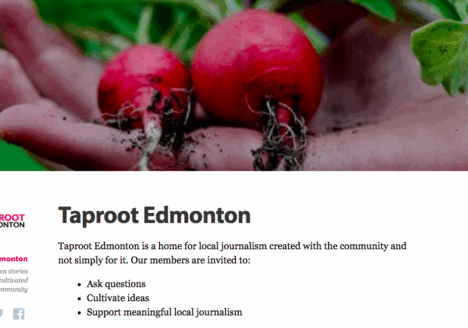
  • Taproot co-founders Karen Unland and Mack Male want stories to answers to questions “planted” by community members and developed by paid freelancers. Screenshot by J-Source.

    Edmonton media outlet Taproot is working on an innovative model for paid reporting work

    This story was funded by the J-Source Patreon campaign. By Trish Audette-Longo Taproot Edmonton’s very first story wouldn’t normally crack a newspaper’s front page or the 6 o’clock news. Posted online in September, “South Edmonton’s surprising deer paradise” was written by freelance journalist Mel Priestley and offers a detailed account of how deer live in the…
  • Photo courtesy of Michelle-Andrea Girouard.

    Journalism internships should be paid fairly and offer personal mentoring

    By Errol Salamon Entry-level media workers can confirm that some journalism internships aren’t as glamorous as they may seem because they’re neither paid fairly nor do they provide one-on-one mentoring. We gathered the stories of four journalism interns to better understand the experiences of emerging media workers in today’s media landscape. Here’s what they had…
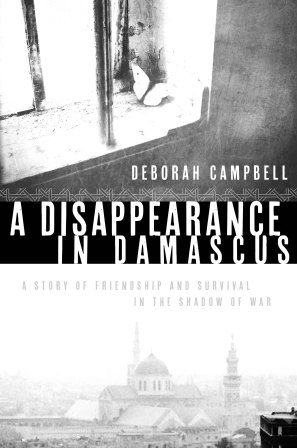
  • campbell.jpg

    A life and death relationship ‘built entirely on trust’

    By David Beers for The Tyee By 2007, the violent chaos unleashed by the U.S. invasion of Iraq four years before had driven hundreds of thousands of Iraqis into Syria. Journalist Deborah Campbell sensed (all too accurately as we now know) that Syria itself risked becoming the next cauldron of unrest. So she left her…

  • Uncharted Journalism Fund will provide $3,000 whole or partial grants four times a year, with the aim of supporting “adventurous” storytelling projects. Screenshot by J-Source.

    How a new B.C. media fund will encourage storytelling innovation

    By H.G. Watson, Associate Editor A group of people in British Columbia are going into uncharted territory to fund new journalism projects. The Uncharted Journalism Fund will provide grants up to $3,000 four times a year, with the aim of supporting “adventurous” storytelling projects, according to a press release. The project is the brainchild of…
  • Media stories that get it wrong can contribute to how others perceive those with autism – and even perpetuate potentially dangerous stereotypes. Photo courtesy Becky Wetherington/CC BY 2.0.

    Five things journalists should keep in mind when writing about autism

    By Laurie Mawlam Too often well-meaning journalists get it wrong when they write about autism.  It’s not so much the content of their stories that misses the mark as the language they use to describe autism itself.  It can be easy to unintentionally offend – or worse, misrepresent -- the autism community you are meant…
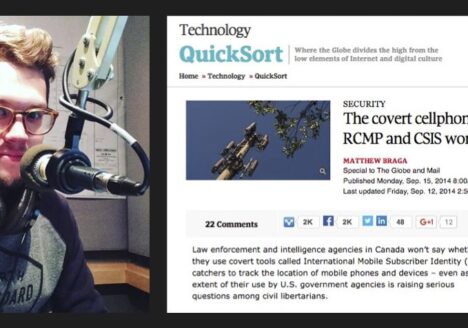
  • Matthew Braga is a freelance tech reporter and lecturer at Ryerson. He broke news about how Canadian police services use cellphone surveillance in investigations. Photo courtesy Matthew Braga/Screenshot by J-Source.

    How Matthew Braga finds scoops on the tech beat

    By Chelsea Lau For Matthew Braga, technology was just an interest at first. He wanted to know the inner workings of technology and how they worked on a technical level, whether it was smart phones, laptops or video games. It was only when he pursued writing that he combined his love of tech with journalism…

  • Farzam Dadashzadeh, an Iranian refugee now living in Vancouver, says he was outed in a 2007 CBC documentary called Out in Iran: Inside Iran’s Secret Gay World. Screenshot by J-Source.

    Newsrooms need to talk about informed consent when reporting on LGBTQ+ communities

    This story was funded by the J-Source Patreon campaign. By Steph Wechsler In August, the CBC was named as a defendant in a lawsuit claiming that Farzam Dadashzadeh, an Iranian refugee now living in Vancouver, was outed in a 2007 documentary called Out in Iran: Inside Iran’s Secret Gay World. The film includes hidden camera footage…
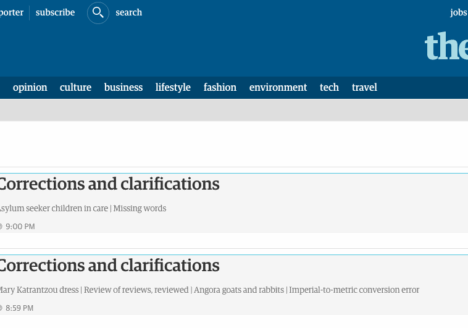
  • The Guardian’s Corrections and Clarifications section is an example of how a news organization can humanize the newsroom. Screenshot by J-Source.

    Owning up to mistakes is a way to build trust with readers

    By Kirk LaPointe If the academic literature suggests one-half of all stories contain a factual error, then it is clear that corrections should be in routine order. But when and how to do so is a debate within journalism, particularly in this iterative age of digital reporting when our craft updates and doesn’t always acknowledge…

  • unnamed-1.jpg

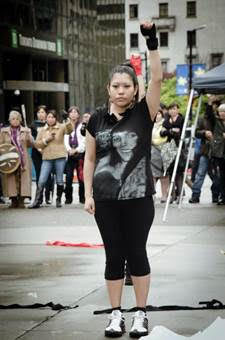
    You don’t know what it’s like

    By Lorelei Williams for the Canadian Media Guild What can media do better in reporting on our missing loved ones? Treat our missing women and girls the same as the others. It has been pointed out several times that when a non-Indigenous person goes missing, the media is all over it, but when it comes…