
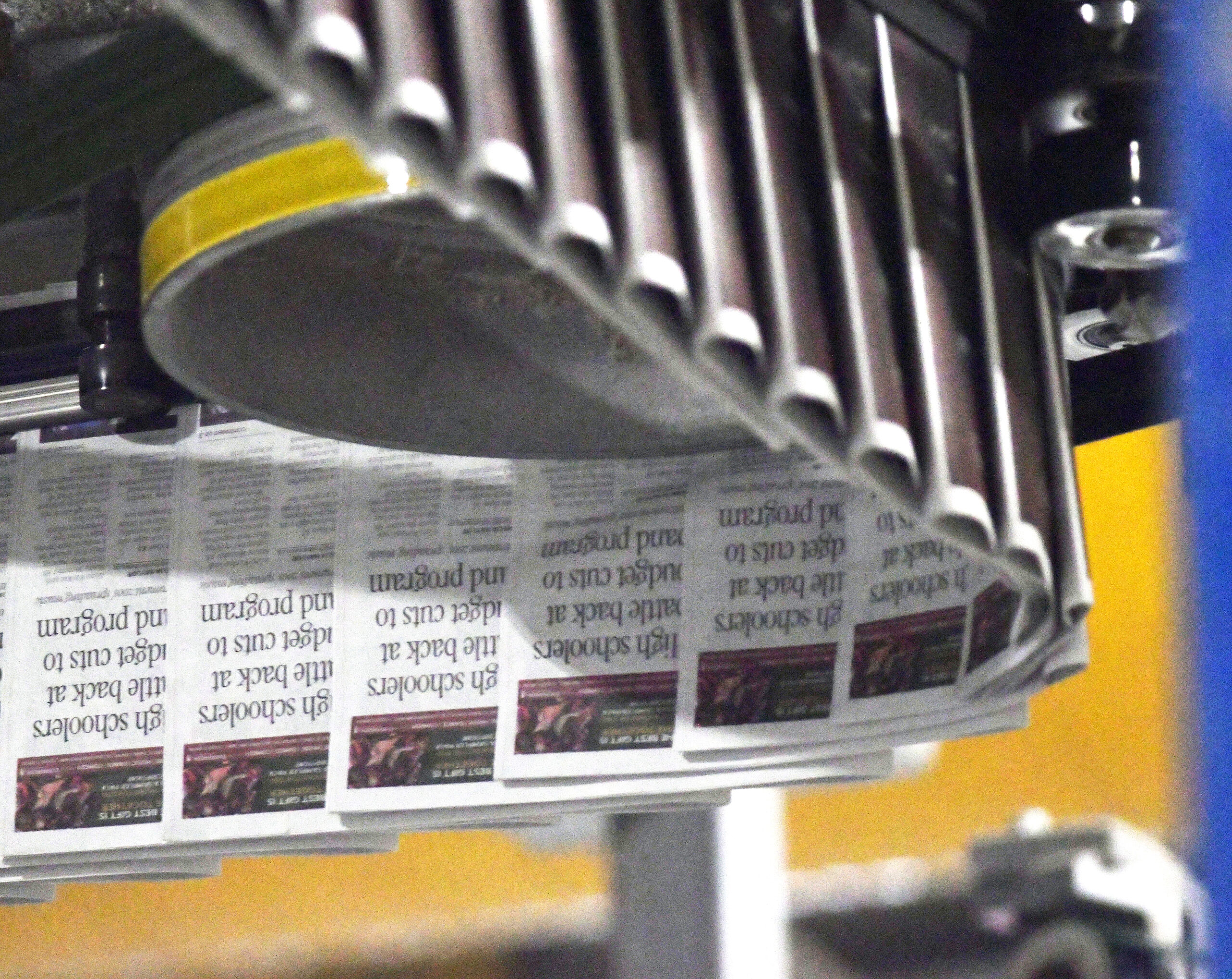
Five months after launch, Freshet News is a landing page for its communities.
With a monthly print edition and daily coverage online, readers of Freshet have the chance to sort stories by area and keep up with daily events through their “What’s On” series.
Longtime B.C. journalist Cornelia Naylor and one of Freshet’s four founders, says they hope to mentor the next generation of local journalists. Naylor works alongside Theresa McManus, Janis Cleugh and Mario Bartel.
Founded as a co-operative news organization, Freshet not only embeds themselves into meaningful stories but fills a void for over 600,000 residents in New Westminster and Burnaby and the Tri-City area when they were left without local news.
Launched last October, Freshet News considers themselves “a disruptive force in the corporate media landscape.”
“We think this model can work for local news,” says Naylor. “And we’re starting to understand just how important it is for the community.”
No news
In fact, sometimes you don’t know how important something is until it’s gone.
For years, the TriCity News, New Westminster Record and Burnaby Now delivered news to residents in B.C.’s Lower Mainland.
In 2023, the three outlets’ parent company, Glacier Media, killed their print editions and by April 2025 all three publications were gone – leaving the communities without local coverage and journalists without their jobs, such as Naylor.
After retiring from her role as an English teacher, Naylor worked as a journalist and reporter in Burnaby for more than 15 years.
Without a newsroom, she found herself considering what was next.
Enter the Union Co-operative Initiative, a “multi-stakeholder community service co-operative composed of the membership groups,” such as community organizations, network union-co-operatives and institutional partners.
After putting out a call to local journalists in hopes of rallying members for a co-operative publication, Naylor, McManus, Cleugh and Bartel formed Freshet.
From the onset, Naylor says their team wanted to understand how the affected communities felt and what they wanted from the emerging publication.
“They told us they had no idea what was going on in their communities,” says Naylor. “I was surprised, I thought, ‘the internet exists, you can just look this stuff up.’”
Without a centralized local newspaper, there was no curated place for people to get their information about daily events besides personal blogs, social media and whatever public organizations could produce from internal media departments.
After launching their website Naylor says they immediately saw web traffic that wasn’t coming and going but rather coming and staying.
“People are really engaging with our content,” she said.
But Naylor and her team knew Freshet’s website wouldn’t be enough to sustain their work financially. Using leftover funds from Glacier Media, Freshet published its first print edition last December.
Printing the press
Establishing a print product didn’t come without its challenges. Naylor says it wasn’t so much the financial implications but their capacity to distribute it.
“It kept me up at night, tossing and turning over how big a bundle is. How much does it weigh? Where do you store it and where do you take it?”
By way of distribution hubs, monthly-printed copies of Freshet are delivered to various locations by friends, family and local community volunteers.
However, capacity remains a hurdle their team faces time and time again. For their first edition they printed and distributed 25,000 papers.
“While we’re running around trying to source racks for our papers in places like grocery stores, we’re not writing stories, and we’re not researching stories,” says Naylor.
She describes a lack of time and capacity as a trickle down effect. If community members aren’t accessing and reading the news, advertisers may be less likely to buy into ad space therefore limiting Freshet’s ability to make money.
Despite their challenges, Naylor is confident that people are interested and engaged in Freshet’s work.
She says people are excited about a print publication, something readers could “get to the end of.” Not only do communities want the news again, they want to hold it.
In fact, one user left a comment for the editor, thanking them for their contribution to local news.
“After so many years of reading material online, I’ve gotten used to it, but it [was] never very pleasant. I’ve had a harder time staying interested in long online articles.When I read the first print edition of the Freshet, I found myself tearing up. I hadn’t realized how much I missed reading a printed newspaper, especially one with local news.”
Unlike the doom of scrolling online, print media has a beginning and an end. There’s no fear of finding yourself in “the abyss.”
Jeremy Klaszus, journalist and founder of independent publication The Sprawl in Calgary, prints zines alongside his digital coverage. He says he’s found that print surprises people.
“I think right now there is healthy pushback against screens and algorithmic life,” says Klaszus.
Both Naylor and Klazsus agree. Print media allows the reader to connect with the story and the people, places and issues it covers in a different way. Combined with an emphasis on local reporting, journalists have an opportunity to meet their readers where they’re at.
Klazsus emphasizes how local journalism, like Freshet, provides “the building blocks for people to form a robust conception of their communities.”
Freshet’s current coverage heavily features hard news and press-release-style stories.
And while the publication strives to fill the shoes that Glacier Media left behind, they find themselves face to face with compromise in the wake of capacity vulnerability.
The local news crisis
Hollowed out. That’s how Klaszus describes journalism today. He says with fewer journalists and fewer publications “the survival strategy is to go hyperlocal.”
According to the Local News Map Data Report by the Local News Research Project published last October, 603 local news outlets closed in 388 communities across Canada between 2008 and October 1, 2025.
Other data about news outlet closures
- 73 per cent of total closures were community newspapers
- In same time frame, 419 local news outlets launched
- Of those 419, 155 subsequently closed
“Local news is the bedrock of a healthy, functioning democracy,” says Naylor. “It sheds light on places that other media don’t go to.”
She says large media outlets often end up “parachuting” journalists who have no local connections into communities, reporting mainly on big stories. Naylor argues it’s the local journalists – the ones with lived experience, context and connection to their community who truly understand how to reach their neighbours.
Freshet aims to maintain a sense of “beat” journalism – a specialized area of coverage such as politics, environment, science, health, crime or education frequently covered by the same specific reporter.
And in order to cover these issues Klaszus emphasizes Naylor’s point.
“You need to hone in on local issues and be okay with leaving the rest. Journalists have an impulse to do it all, capture it all. But you can’t.”
Klaszus and The Sprawl focus mainly on municipal issues in Calgary. For more than a decade, Naylor covered city hall and school boards in Burnaby. In doing so, like Klaszus, she’s developed an “institutional body of knowledge” that regional or national journalists often lack.
“That’s what I love about local journalism. You can really sink your teeth into the story you tell,” says Naylor. “There’s no rush, it’s just us. We take our time, know the context and get below the surface.”
She says one of the difficulties large newsrooms face is finding their place in smaller communities. If hyper-local news really matters to an audience, Naylor questions how that coverage fits in without getting lost.
“You can’t rescue local with regional, or even national. Where’s the mechanism for the community to engage with, when it’s thrown into a sea of other stories.”
The (co-op)portunity
Co-operative ownership has a long history in the Canadian media landscape. Often an alternative to mainstream media, co-ops have been a “persistent force” across Canada for over 100 years including outlets such as B.C.’s CHEK TV and Saskatchewan’s Prairie Dog and Plant S Magazine.
Klaszus says independent and co-operative local reporting gives journalists a chance to exist outside of institutional obligations and readers the opportunity to get in touch with a bigger, deeper sense of their communities.
This is what he says fosters creativity in journalism. When you exist outside of mainstream media you escape the need to “fill a particular bucket.”
Mitch Diamantopoulos, an associate professor at the University of Regina’s School of Journalism and department head says co-operative journalism often found in “news deserts” or areas that lack local specified news organizations.
Diamantopoulos is a research fellow at Canadian Centre for the Study of Co-operatives and is the founder of the co-op initiative that published Saskatchewan’s Prairie Dog and Plant S.
“The ownership model matters when it comes to trust,” he says. “Co-ops can help deal with a failure in the market to help deliver quality news but also the failure to deliver viewpoint diversity.”
He argues we often settle for “good-enough” journalism by for-profit publications such as Glacier Media or the CBC that try to do everything. “They can’t be everywhere and we shouldn’t want them to be either.”
By emphasizing the potential for news co-operatives to enter the market in a way that serves underserved communities he suggests there is potential for publications such as Freshet to take off.
There are many incentives that encourage co-ops to succeed. Diamantopoulos says economic benefits are just one.
Incentives exist for “people who want to do real, good journalism – who want to keep professional standards high and feel they’re unable to do that in a rapidly downsizing and compromised media environment.”
These are the people who want to keep “the democratic mission of journalism alive,” he says.