
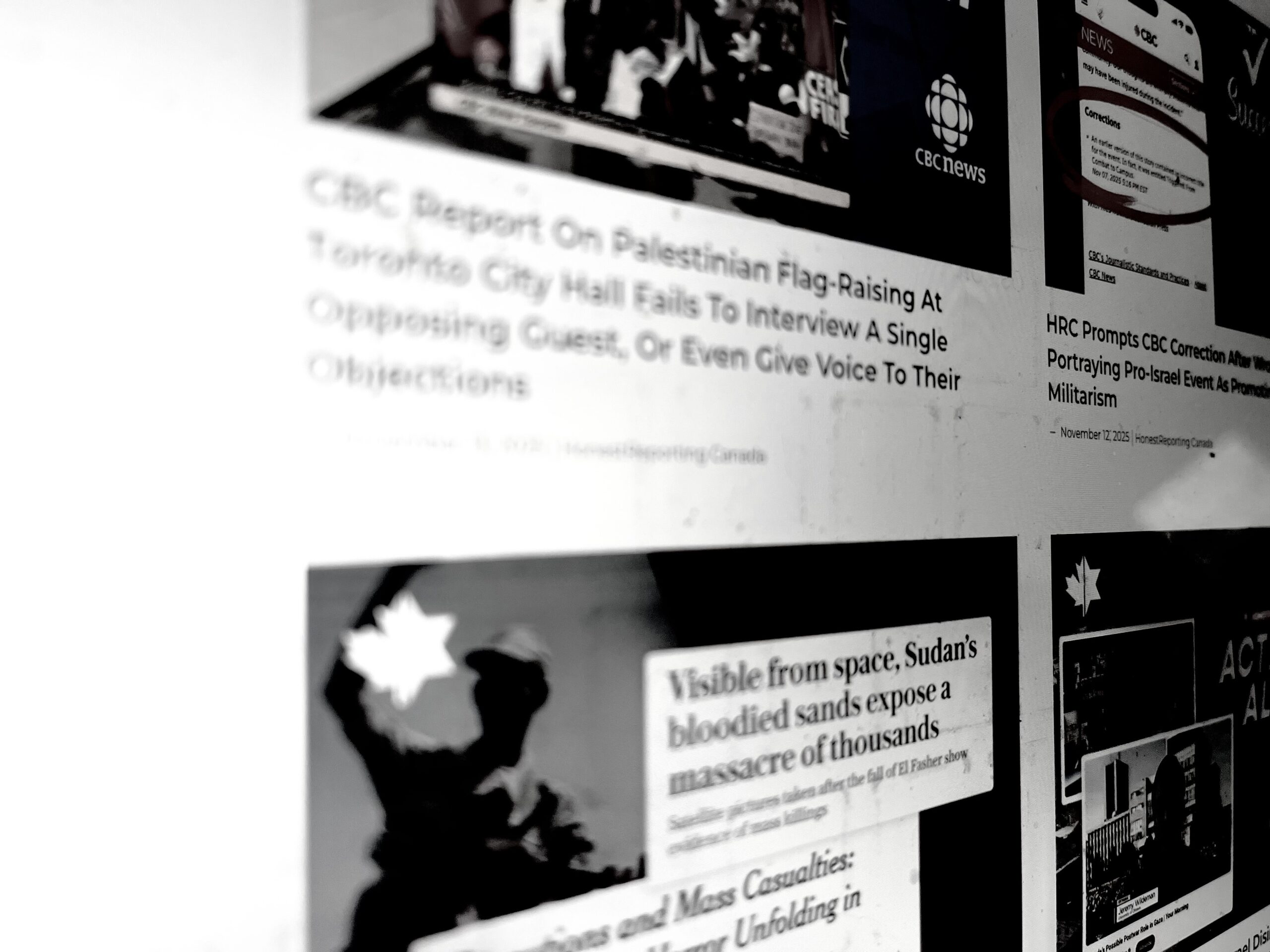
A self-professed media watchdog has been weaponizing antisemitism and trying to poison journalistic standards on covering Palestine. Media workers on the perils of the relentless intimidation and disinformation manufactured by a ‘digital army for Israel’
When Samira Mohyeddin was a CBC producer, she would mark a “P” on her desk calendar every time editors rejected one of her story pitches related to Palestine.
“Boy, were those P’s adding up by the time the year was done,” she told J-Source. Editors gave a variety of reasons for saying no — but in her experience, one came up over and over: the flood of critical emails and messages which editors had come to expect from readers of HonestReporting Canada.
HRC describes itself as an “independent grassroots organization promoting fairness and accuracy in Canadian media coverage of Israel, the Middle East and issues related to and affecting Canadian Jews.”
Founded in 2003, the organization monitors media coverage related to Israel and Palestine and publishes regular alerts encouraging followers to complain to newsrooms about reporting which the organization sees as critical of Israel. HRC’s alerts often name specific journalists and include their photos, and routinely accuse them of antisemitism or supporting militant groups or terrorist acts.
HRC doesn’t just target journalists. In one case, the organization accused Aidan Simardone, an immigration lawyer, of “glorifying terrorism,” and described him as “a stain on the legal profession” and “a potential security threat.” The alert included a shirtless photo of the lawyer, which HRC later removed. Another HRC alert targeted a doctor and included a photo which had been edited to add what the doctor described as a “sexualized body.”
In 2024, the organization’s assistant director, Robert Walker, was charged with 17 counts of mischief in what Toronto Police concluded was a “hate-motivated” incident in which anti-Palestinian graffiti including “Fuck Gaza” was spray-painted in several locations along a Toronto street. The charges were withdrawn in March 2025 after Walker and his two co-accused made donations to a Toronto hospital. HRC never commented on the incident; Walker remains the organization’s assistant director.
HRC did not respond to requests for comment.
In addition to its campaigns targeting journalists in Canada, HRC often accuses Palestinian journalists killed by Israeli strikes of being Hamas militants. Journalists are civilians under international humanitarian law, and targeting them is a war crime — but HRC routinely celebrates these strikes, including an Israeli airstrike that killed four Al-Jazeera journalists outside a hospital in Gaza City in August 2025.
Responding to a CBC journalist reporting on the targeted strike, HRC wrote on X: “A terrorist with a press vest is still a terrorist,” and in another post, “Name a better duo… @CBCNews and the whitewashing of terrorists … Stop pushing Hamas propaganda!”
To a journalist with CP24 and CTV, HRC replied: “Stop lamenting dead terrorists … Delete your whitewash.” This has been a theme from the organization, which has also justified the killings of journalists Hussam Shabat, Hassan Aslih and Ismail al-Ghoul, among others.
Social media rhetoric is just a small part of HRC’s lobbying. J-Source and CPFP have been gathering data on the extent of the organization’s pressure campaigns against media workers in Canada, and have spoken with dozens of those whom HRC has targeted. Many described receiving hundreds or thousands of emails, including abusive language and threats.
“I’ve always seen them as bullies. I really think that that’s what they are, and that’s the best name for them. They try to bully journalists who are telling the truth that they don’t want to hear,” said Farah Nasser, whose reporting was repeatedly targeted by HRC during her nearly 10 years as an anchor for Global News.
“If I get my facts wrong, come after me, please. I want you to come after me, because I want to get them right,” Nasser said. But HRC’s pressure tactics go far beyond good-faith criticism, she and other journalists who spoke with J-Source argued. “Their methods are extremely dangerous to journalism,” she said.
According to many who spoke with J-Source, HRC’s tactics are in effect a targeted harassment machine which aims to chill any reporting on Israel and Palestine that is not entirely in line with current Israeli government policy, or that acknowledges the existence of Palestinians at all.
Many of the journalists who spoke with J-Source noted that their reporting on Israel and Palestine tends to attract complaints and pushback from a range of perspectives — but the efficiency and scale of HRC’s tactics, developed over more than two decades of pressuring Canadian newsrooms, threatens accurate reporting on a vital story, they argued.
“HonestReporting has done a lot to create that kind of culture of fear and self-censorship, which to me is extremely anti-democratic,” said Saba Eitizaz, a podcast producer with the Toronto Star.
Several journalists who spoke with J-Source noted that the organization funding that rhetoric is registered as a charity through the associated HR Canada Charitable Organization, which can issue tax receipts — in effect allowing Canadian tax dollars to subsidize attacks on journalists in Canada.
Some media workers told J-Source that newsroom leaders didn’t take HRC’s campaigns seriously, and that they could count on editors to stand by their reporting. But others said editors and managers were swayed by the organization’s pressure tactics, and described being reassigned from Gaza coverage and having pitches shot down or coverage edited to satisfy complaints — or re-shaped before publication to head them off.
Newsrooms that have been outspoken about supporting journalists facing online abuse have been largely silent in the face of these persistent campaigns which direct targeted harassment at their employees, noted other journalists who spoke with J-Source.
The industry’s collective failure to mount a serious response to this harassment, and the deference some newsrooms show to the pressure, represents a serious threat to the public perception and practice of journalism at a critical moment, journalists told J-Source.
“Sensible editors have long disclaimed taking HonestReporting Canada seriously. But I think the last year has shown that that’s simply not true … They do take those calls, and they do act on bad-faith, uncharitable interpretations of what’s been said, and try to dot the i’s and cross the t’s in such a way that it is beyond criticism of the pro-Israeli lobby,” said Shree Paradkar, a journalist with the Toronto Star.
(Paradkar was a columnist with the Toronto Star when she spoke to J-Source, and is now an investigative journalist at the paper. Since the reporting of this story, she has joined CPFP’s advisory board).
That response amounts to a profound reshaping of the basic idea of journalism, Paradkar argues — from informing the public to satisfying a particular narrative. “I look at it as a fundamental failure of our journalistic duties, or betrayal of the profession itself,” she said.
Scale of HRC pressure
Data collected by J-Source and the Canada Press Freedom Project show that the organization has published at least 1,296 alerts naming individual journalists between Jan. 1, 2021 and Oct. 7, 2025.
That number includes only reports which named individual journalists and which also included a form to contact them or their newsroom, or some other way to contact them. Many reports named journalists or media organizations but did not provide a way to contact them. CPFP’s documentation has focused on alerts with both elements because, based on conversations with journalists, these appear to generate a larger volume of harassment.
While collecting this data, CPFP observed that HRC appears to update alerts if publications respond to HRC pressure and make changes to published articles; because they are not described consistently, these incidents are excluded from CPFP’s numbers, which therefore slightly undercount the total number of alerts.
Of those 1,296 alerts, nearly 90 per cent — 1,152 in all — were published in the two years following Oct. 7, 2023, when HRC ramped up to publishing an average of about two alerts every day, following the Hamas attacks on Israel and Israel’s subsequent military campaign, which has been described as a genocide by a UN commission, genocide scholars and legal experts.
“It’s imperative that we operate by the maxim that the best defense is a strong offense and work to control the narrative,” HRC executive director Mike Fegelman wrote in a fundraising email on Oct. 16, 2023.
Journalists who have been named in those reports have described receiving floods of emails and messages on social media.
“I have gotten quite a lot of heinous emails talking about my race, my gender … Your general anti-immigrant stuff — like, ‘You don’t belong here,’” recalled Brishti Basu, who worked at CBC as a senior writer until 2024 and has been named in several HRC alerts.
Between waves of harassment, Basu said she mostly heard from readers who appreciated the coverage of the conflict and asked her to keep it up. Others offered tips or shared stories about relatives in Gaza.
Many journalists who spoke with J-Source also said they had scrubbed their contact information online and retreated from social media — making them less accessible to harassers, but also potential sources.
But many of her articles also prompted media alerts from HRC, urging readers to complain to CBC about Basu’s reporting. The largest batch of emails came after HRC published a media alert about an explainer she wrote for CBC about the phrase “from the river to the sea,” she told J-Source. Each alert seemed to provoke an avalanche of messages and mentions on social media, as well as emails to her CBC account and to a personal account via a contact form on her website — which she took offline as a result of the harassment.
Many journalists who spoke with J-Source also said they had scrubbed their contact information online and retreated from social media — making them less accessible to harassers, but also potential sources.
The harassment and threats are frustrating, Basu said — but she believes in the reporting. “This is the least horrible thing that could happen to me for writing truthfully about what’s happening,” she said. “Far more people have paid far greater prices for doing that. This is not to trivialize the threats that we get — that’s not OK at all — but that’s how I kind of put it in a box in my head; it lives there and I can focus on moving forward.”
In Vancouver, Spencer Izen, opinion and deputy managing editor at the Ubyssey, recalled waking up at 4 am to his iPad pinging non-stop as emails from HRC readers flooded his inbox — in all, about 1,500 emails in a single day, after HRC complained about the student newspaper’s reporting on a campus protest.
On an average day, he gets at least one or two emails related to HRC campaigns — adding up to a total of between 5,000 and 10,000 during his time at the paper, he estimated.
In May 2024, Eitizaz interviewed Mohyeddin and Montreal journalist Christopher Curtis for an episode of the Star’s podcast about campus protests against the war. HRC published a media alert about the episode, complaining about how Eitizaz had handled the interview and urging readers to write to the Star’s editors.
The alert named Eitizaz and Mohyeddin — although not Curtis, who noted on social media that he had expressed similar views but wasn’t targeted: “I was on this podcast saying the exact same thing my colleagues are being harassed for. The only difference is I’m white and they’re not … Honest Reporting continues to target women of colour to push their pro-war agenda,” Curtis wrote.
The HRC alert included a photo of Eitizaz, as well as her email address and a form to send pre-written emails to the Star. “I was flooded with emails the next day — hundreds of them,” she said.
Nearly all were copy-and-paste emails sent using a form on HRC’s website which allows readers to blast journalists and newsroom leaders with form letters in just a few clicks. Reading through the identical emails, it was clear that this wasn’t anything close to a good-faith attempt to engage critically with the reporting, Eitizaz recalled.
“Nobody was listening to the podcast, or what I said, or what the content was. They were just bombarding me with emails based off of that template,” she said.
Effect on coverage
Several journalists told J-Source that HRC’s campaigns came up in newsroom discussions about coverage.
“‘We don’t want to deal with the letters.’ That’s what you will hear your senior producers, your executive producers, your managing director say all the time — ‘We don’t want to deal with the letters.’ ‘Let’s not focus on this right now.’ ‘Let’s do something else.’ Or, ‘Maybe we’ll come back to this,’” recalled Mohyeddin, who left CBC in 2023 and now runs independent publication On the Line.
“I can tell you from experience that when you pitch anything on Israel or Palestine, HonestReporting always comes up in the pitch meeting,” Mohyeddin said. “To think that HonestReporting is just, as they claim, a media advocacy group that wants to keep media in check — that’s not the case. They are very much in the head and in the editorial newsrooms of media outlets across Canada.”
A CBC journalist recalled an editor saying that the outlet would only take on the most significant news from the region, because even small stories attracted hundreds of complaints, creating hours of work for staff who had to go through them and assess whether any had merit. The editor said something like, “It’s just not worth it,” the journalist recalled.
At another national publication, a journalist recalled getting feedback on drafts from editors and hearing them repeat phrases and specific criticisms which HRC had published about the journalist’s work: “They seem to be echoing what HonestReporting was saying,” the journalist said.
Several journalists at different publications recalled being asked to change words or phrases or cut quotes to avoid words like “apartheid,” “occupation” or Palestine. Other journalists described being asked to edit stories before or after publication to create what they felt was a false sense of balance between both sides of the story.
Anything related to Israel and Palestine or the region went through levels of verification far beyond what was typical for reporting on similar stories in other conflicts, journalists at several Canadian newsrooms told J-Source. At least some of that hyper-vigilance seemed to stem from pressure from HRC and other advocacy groups, they said.
“We went over it and over it with a fine-tooth comb, to make sure that no one could level any accusation,” Mohyeddin said of her reporting at CBC. “It always blew my mind that it would go through three senior producers, then the exec, then the managing director would listen — it was just wild — for one piece to go on the air,” she added. “And we would still get the letters. I would always say to them, ‘Guys, we’re still going to get the letters. It doesn’t matter.’ And lo and behold, they would always come. It didn’t matter. It doesn’t matter how sound the journalism is. They don’t like you to cover this issue. That’s it.”
It wasn’t just about Palestinian voices: when she worked on CBC’s The Current, Mohyeddin recalled pitching a story focusing on the perspective of young, left-wing Israelis — a viewpoint she felt was undercovered. Instead, the pitch was shut down — editors felt that the perspective didn’t represent a majority view in Israeli politics, she recalled. “I was perplexed — what does that even mean?” she asked. “This was stuff that we were supposed to cover.”
Her account lines up with those of other CBC contributors who spoke with J-Source on background, and with previous reporting detailing the experiences of contributors to the CBC and other Canadian publications.
In 2021, HRC complained to CBC about an episode of the show Unforked hosted by Mohyeddin which looked at the history and politics of hummus. HRC claimed the episode’s framing amounted to “an erasure of three thousand years of Jewish history in Israel.”
The ensuing complaint process lasted for nine months, during which Mohyeddin was regularly pulled into meetings with senior editors to discuss her reporting. “It was mortifying. Every day I went to work, I thought, ‘What’s going to happen today?’” she said. “It felt like a witch hunt.”
In 2022, the CBC ombudsman partially agreed with HRC’s complaint about Unforked, writing that the hummus episode “did not meet the expectation of balance” for CBC reporting. The show was not renewed.
“You learn to just stop pitching the story, because not only do you not want to be branded as a person who’s a troublemaker — because that’s what you’ve sort of become — you also don’t want to deal with the threats”
In November 2023, HRC claimed another victory after complaining to CBC about a post Mohyeddin shared on social media which noted an Israeli cabinet minister celebrating the arrest of Palestinian activist Ahed Tamimi. In response, a CBC spokesperson said that Mohyeddin’s tweet “did not contain the level of context we expect that would meet our standards.”
Those experiences were part of the reason behind Mohyeddin’s decision to leave CBC and start her own independent publication, she said. “It always seems like the CBC throws HonestReporting a bone, to quiet them — but at the same time, throws their journalists under the bus,” she said.
Another CBC contributor recalled similar experiences: “Anyone that has done reporting on Palestine that is critical in any way (of Israel), at the CBC, is subject to a lot of meetings and a lot of long discussions with people in positions of power,” they said. “A lot of people have been able to do a lot of good journalism on this beat at the CBC — but everyone self-censors.”
Mohyeddin said that by the end of her time at CBC, she felt “beat down” by the constant need to defend her work. “You get to the point where you totally self-censor, and you think to yourself, ‘I’m just gonna hold on, go through the day.’ … Sometimes, I wouldn’t even pitch. I’d say, just let them assign me. It was easier,” she said.
“You learn to just stop pitching the story, because not only do you not want to be branded as a person who’s a troublemaker — because that’s what you’ve sort of become — you also don’t want to deal with the threats,” she said.
Those threats come from people outside the newsroom responding to HRC’s complaints — but also from within, she added: “They also come from your managing directors, your senior producers, your executive producers, who say, ‘We’re worried about you.’ They bring you into the office, as a sort of — ‘We’re worried about you. Is everything OK? Are you OK? We have this complaint; I have to respond to it.’”
A spokesperson for CBC did not respond to a request for an interview.
Chill
In 2020, when Paradkar filed a column about the chill around criticism of Israel, the piece went through so many rounds of edits that she considered pulling her byline. “Columns would usually take a day or two to edit. This took a whole week where it went up and down the chain,” she recalled. “There was fear — such that I started to get scared too, because I didn’t understand what the fear was. I don’t know that anybody understood what the fear was.”
Several journalists echoed this assessment, describing a vague feeling of nervousness in the newsroom when it came to reporting on the subject. They described a hard-to-define chill, which is sometimes made explicit — remove this word, don’t put this guest on live TV, play up this quote — but which more often exists in grey areas, where journalists pull back on pitches, contractors let edits slide or editors ask for additional layers of verification or say no to all but the most pressing stories.
HRC didn’t create that chill — they’ve just perfected its weaponization.
“The chilling effect almost comes more at the decision-making level — who you’re going to send where, and what stories are going to get commissioned,” a CBC journalist said. “I don’t know how you capture this in an article. This is part of the problem — nobody even knows what the rules are, so you don’t want to go too close to the edges.”
HRC didn’t create that chill, many journalists who spoke with J-Source noted — they’ve just perfected its weaponization. “It’s an institutional issue. It’s not just external forces,” another CBC journalist told J-Source.
“I think it’s wise not to overemphasize a shift in reporting based on HRC’s interventions — and also, to take a broader view of coverage of Israel/Palestine prior to HRC’s involvement, and to think about trends and patterns of Islamophobia and anti-Palestinian racism that long precede HRC’s interventions into Canadian newsrooms,” noted Shiri Pasternak, a criminology professor at Toronto Metropolitan University who is affiliated with the Jewish Faculty Network.
Part of those campaigns, she notes, is the systemic and long-standing conflation — by Israeli authorities and their defenders, including HRC — of antisemitism with criticisms of Israel.
“To me, the most important aspect of their pressure campaigns against the media is not what we’re reading, but what we’re not reading — because it seems like what the whistleblowers are disclosing, and what HRC is bragging about in their own reports about the impact of their pressure campaigns, is that there’s a tendency to obey in advance,” she said.
“I think that’s a key form of power,” she said. “It seems like, from whistleblowers — what’s happening is, there’s enough pressure created within news organizations that have an intolerance for the kind of massive backlash to reporting really critical journalism about Palestine and Israel. That in itself acts as a kind of silencing of what we potentially could be reading, and the critical stances that news outlets potentially could be taking.”
After a week of edits, Paradkar decided to keep her name on the column. “Naively, I thought, if I keep just keep at it, then maybe it will break open the dam and others will see that it’s OK to write about this,” she said. When the column came out, HRC immediately complained, accusing Paradkar of ignoring what they described as the “intimidation of pro-Israel students on Canadian campuses.”
Newsroom response
While some newsroom leaders seem to pay attention to HRC’s pressure campaigns, many have been less responsive to the resulting campaigns of harassment targeting their staff, according to several journalists who shared similar accounts with J-Source.
“I was always told that my journalism is completely sound — they stand behind it. But at the same time, they’re aware of these threats and this level of harassment, and they also don’t do anything about it,” said Basu, the former CBC journalist. “They could easily put out a message to the public saying, ‘Our journalists are being attacked by this organization for doing journalism that we stand behind — we denounce it,’ or something like that. And that never happened.”
When Basu sent examples of harassment to CBC management and corporate security, she was told that there was little they could do unless she was receiving explicit threats of physical violence. The company offered to help her lock down her social media accounts, which she had already done.
Other journalists reported similar experiences. At another national publication, a different journalist targeted by HRC campaigns recalled that as emails and social media messages flooded their accounts, they heard nothing from newsroom management.
Not long before, colleagues in their newsroom had pressured management to develop policies to respond to targeted harassment campaigns, in response to waves of online abuse against media workers across Canada which escalated during the pandemic.
“When I used to get harassment or this kind of thing, I would immediately have somebody checking in,” the second journalist said. But as threats and harassment from HRC readers rolled in, editors and newsroom leaders were silent. “Nobody checked on me. It was almost like it was legitimizing this criticism,” the journalist said.
In 2021, when People’s Party of Canada leader Maxime Bernier named several individual journalists in a social media post and urged supporters to “play dirty,” media organizations and publications widely condemned the outburst as dangerous and undemocratic. “The criticism of that was swift, from all institutions,” noted Paradkar, the Star columnist. “Now, you have a lobby group for another foreign government which is able to do exactly that, and more, for years — for decades — and apparently we can’t do a thing about it.”
“All you need is to know that your company has your back,” she added. “It doesn’t have to be a big statement. It doesn’t have to be expensive. You just need to know that your company is backing you. And I think, often, when that piece is missing, it makes people vulnerable — and so the companies, the industry itself, contribute to that silencing,” she said.
Insecurity
Given the catastrophic Canadian media landscape, with many journalists on contracts and looking over their shoulders for the next round of layoffs, several who spoke with J-Source echoed concerns about professional consequences of covering the story — including worries about being seen as “difficult” if they pushed back on edits and coverage choices, as well as the implications of smear campaigns turning up in search results for their byline.
A CBC journalist recalled an argument with an editor who wanted to remove words from a quote in an interview in a story related to Gaza. The editor expected the words would attract complaints and didn’t feel they could push for them to be included.
The editor said something like, “I’m the one that’s going to have to pay for this. It’s going to cost me,” the journalist recalled. “Part of the problem is that that person also feels their job is insecure,” the journalist added.
Reporting on this issue presents a constant moral dilemma: “How much do you push?” the journalist asked. Is it better to concede the smaller battles, if arguing means risking a job where it’s still possible to do some good reporting on the subject? “Balancing that can be really tough,” they said.
At the same time, they noted that they had routinely seen editors assign Israel-Palestine stories to junior reporters with little experience covering the region. “I sometimes get this feeling like it’s almost easier for them, because those people will just read the wires and they will not push back on anything,” the journalist suggested.
Another journalist at a national publication described a similar trend, believing that some editors may feel more comfortable assigning potentially controversial stories to journalists who feel less secure in the newsroom and are less likely to push back against edits — which can be justified “in the name of ‘guiding a young journalist,’” they said.
Whether those fears are realized or not, they contribute to a chill on reporting on the subject, several journalists told J-Source.
At the Star, Paradkar recalled a young journalist hesitating to take on an assignment to cover an anti-war protest, because of concerns about online harassment and career implications that might result from touching the story. “I don’t blame them for that at all. They still have student loans,” Paradkar said.
“What’s the incentive for a young journalist right now to actually criticize power?” she asked. “The power imbalance in the situation is so ridiculous that when HonestReporting Canada comes into the picture, it puts a huge weight on a scale that is already completely out of balance.”
By now, Paradkar has become such a frequent target for HRC that the organization’s website is almost a backup page for her work, she jokes: “You can find my articles on thestar.com, or if you want to read my articles on Israel-Palestine you can find them on HonestReporting.”
The criticism doesn’t bother her — but she acknowledges that those professional concerns can still linger in the background, even for well-established journalists who trust that their publication will stand by them in the face of bad-faith criticism: “I don’t know. Maybe nobody will ever hire me again. Maybe somebody will hire me, but nobody will hire me with the job that I have now, with the benefits I have,” she said.
At the same time, many of those singled out by HRC, including many repeat targets, are racialized, which magnifies all of the existing concerns about precarity. Data from the Canadian Association of Journalists’ annual newsroom diversity survey show that those same journalists are less likely to be in senior management positions, and more likely to be employed part-time, with more to lose by speaking up in a profoundly insecure industry.
These jobs offer the least stability and are often the first to go in layoffs. As the industry’s finances continue to tumble, newsroom diversity is worsening — or at best, stagnating. Greater insecurity only reinforces the bigger socioeconomic factors that affect the types of people who are, in general, more able to afford to choose or stay in a field with no stability and such miserable financial prospects.
This all comes as many of those same journalists are fighting within their newsrooms for accurate coverage of the ongoing conflict and genocide.
“We’re already under significant pressure trying to cover what is happening in Gaza and what is happening in the Middle East with integrity,” said a journalist who has been targeted by HRC. “There’s been a big split and overall polarization within our newsrooms over Gaza. It obviously involves a lot of the racialized journalists — and now when the harassment comes, it has all of those connotations as well,” said the journalist, who is Muslim.
There’s a long list of examples of media organizations cracking down on the mildest expression of support for Palestinian human rights — in an industry which appears to have no problem with colleagues expressing clear, public support of Israeli policy.
In this precarious context, it can feel like an existential risk to speak up for better coverage and to keep making the arguments that feel morally necessary. “You don’t know what the repercussions of something like this will be,” the same journalist said. “I don’t know how this is damaging me in the long run, and what will happen to my future and my career here. A lot of us are at this stage right now, racialized journalists — we feel like we’re burning bridges just by covering this essential story.”
If many of the media workers who are most likely to be targeted are also those held to a double standard of objectivity, and among the least secure in the newsroom, the pressure is unrelenting, several journalists targeted by HRC told J-Source.
Effect on individual journalists
Harassment for reporting on Palestine began early in Farah Nasser’s career, before she worked as an anchor at Global. Covering news on the overnight shift at a Toronto radio station a few years after 9/11, she remembered that any time she mentioned Israel or Palestine — even if she was just reading wire copy — the phone would reliably ring with listeners calling in at all hours to complain about “anti-Israel bias.” Many would mention the fact that Nasser is Muslim, she noted.
She couldn’t remember if the calls were associated with HonestReporting or another lobby group, she said. But the message and apparent intent was familiar: shut down reporting on the subject.
“When I was young, it was very jarring,” she recalled. “It’s vulnerable — you’re there in a big newsroom in the middle of the night alone, and you’re getting these calls telling you that you’re completely biased and that you shouldn’t be there. And already, as a young brown girl in the early 2000s, right after 9/11, you have impostor syndrome. And then there’s somebody who’s just on you. It’s scary — and it would happen night after night.”
“When I see bloodshed and violence and massacres of innocent people happening, I have to write about it. I have to talk about it. And so there’s that additional grief of seeing that, and then the stress and the fear that surrounds me having to build up the courage to do that”
Years later, when HRC began directing readers to complain about Eitizaz’s reporting at the Toronto Star, it wasn’t the first time she had been singled out for abuse and threats of violence because of her work. Eitizaz has reported extensively on conflict and other difficult subjects, and has weathered many campaigns of harassment and threats — including from the Taliban, who threatened to kill her and her colleagues at the BBC in Pakistan, where she worked before moving to Canada.
After that experience, the growing waves of harassment related to reporting on Palestine left her concerned. “It’s a psychologically very intimidating feeling … I know where these things can escalate and lead,” Eitizaz said.
“I have so much practice, for most of my career, trying to fight for a free press and for journalism against literal military dictators and the fear of surveillance and censorship,” she said. “All of those feelings have come back,” she said.
She described a sense of constant surveillance — a feeling echoed by other journalists who spoke with J-Source. Now, Eitizaz said she triple-checks posts on social media before hitting publish, and keeps an eye on which of her posts are being bookmarked — is someone saving an article to read later, or to file away for future harassment?
Several journalists said that anticipating harassment and waves of messages has made them anxious about publishing anything on the topic. “You have to sort of build a shell around you before taking on the story, because you know what’s coming,” Eitizaz said.
For many, this has led to a separate feeling of moral injury — trapped between a sense of journalistic duty, and knowing that taking on stories about Gaza and Palestinians in general means signing up for harassment.
“I literally have a physical reaction to doing a Gaza story. It’s tearing my soul apart,” Eitizaz added. “When I see bloodshed and violence and massacres of innocent people happening, I have to write about it. I have to talk about it. And so there’s that additional grief of seeing that, and then the stress and the fear that surrounds me having to build up the courage to do that.”
The harassment campaigns also have effects beyond the newsroom: Nasser recalled a message to her mother from a long-time family friend, who forwarded an email from HRC’s mailing list condemning an interview Nasser had just done with Siyabulela Mandela, the great-grandson of Nelson Mandela.
“So disappointing that I felt compelled to sign a petition against this Global report,” wrote the friend, who described Nasser and her mother as two women who “I once held in such high esteem.”
Divisive rhetoric
Journalists targeted by HRC also described how the organization’s use of identity as a weapon deepens divisions, and plays on painful questions about how individuals fit into a community.
A Jewish journalist who has written critically about Israeli government policy and who has been targeted by HRC described emails and social media mentions calling them a “kapo” — a term from the Holocaust used to describe concentration camp prisoners assigned by Nazi authorities to supervise others.
Izen, the Ubyssey editor, listed some typical messages out of the thousands he has received from HRC readers: “You’re an unethical journalist; you’re spreading antisemitism … You’re a self-hating Jew.”
Although he said he continues to think about these questions — after thousands of emailed accusations of antisemitism, the thought has crossed his mind — he’s comfortable with how he answers them for himself: “I have a very privileged position to basically look at it and go, ‘I’m Jewish. They’re Jewish. I know what antisemitism is. This isn’t it. I’m done.’”
More troubling, he said, is what the messages signify. “I know that when I bring my identity to the job, the way I manifest it is not one that is typically respected by the majority in my community,” he said. “Their emails do remind me that — as much as I believe in the acceptability of my conception of antisemitism — being Jewish, and a member of the diaspora, I know that I am not in the majority.”
As an editor, this also creates practical concerns, he added. He talks enthusiastically about helping first-time opinion writers develop opinions and sharpen arguments, and he is full of praise for their work. But he worries about how the toxic rhetoric shapes the assumptions readers and would-be contributors might make about his political views — and also his ability to edit their work and produce a section that presents a wide range of opinions.
“They’re also — I think quite cynically — stirring up as much fear in the Jewish community as possible in order to defend Israel. And that, to me, is so morally reprehensible and so completely antisemitic”
This divisiveness is a feature of HRC’s lobbying, explained Shiri Pasternak, the TMU professor and Jewish Faculty Network member: the organization insists on “really specific and narrow and biased interpretations of unfolding events,” she said. This has both religious and political roots, she argues.
“They have these religious understandings of Jewish people as belonging in Israel, and feel like any attack on that legitimacy to be in Israel — at any cost whatsoever — is some kind of attack on the Jewish nation … There is some deep ideological extremist philosophy and theology behind what they’re doing,” she said.
At the same time, the organization seems to see its mission as “an arm of the Israeli state,” she said. “They’re also — I think quite cynically — stirring up as much fear in the Jewish community as possible in order to defend Israel. And that, to me, is so morally reprehensible and so completely antisemitic,” she said.
This philosophy leaves no room for dissent or different ways to understand identity, she said. “I’m a Jewish person who’s critical of Israel. I have an Israeli passport; my mother is Israeli, both my grandparents were born in Israel. My family’s kibbutz was one of the ones attacked on Oct. 7, and I lost family,” she said. “How dare you tell me what my position on Israel should be?”
Drawing on traumatic history, these tactics stoke fear and hysteria, she argued. “They’re not just tapping into trauma; I think they’re actually creating new forms of vicarious trauma through their reporting. I really find it morally reprehensible and so destructive to … my own community,” she said.
The inflammatory rhetoric also has broader effects on public dialogue, aiming to polarize the issue along identity lines.
At the Winnipeg Free Press, John Longhurst — the only journalist reporting full-time on religion at a Canadian daily — told J-Source that it’s a “fraught time” for interfaith dialogue.
“I don’t write to inflame. I write to inform, and to challenge and to make people ask questions. I’m not incendiary in my column-writing — so I tend not to get angry emails. But since Oct. 7 — and every journalist across the country would probably say the same thing — the whole area is a field of landmines,” Longhurst said.
In Dec. 2024, Longhurst was named to the Order of Canada — appointed, the Governor General wrote, in recognition of his extensive work as a journalist “to promote positive interdenominational relations, to reduce hate and to help readers see the humanity in every person.”
HRC feels otherwise about Longhurst’s writing. They claimed that a 2024 column about aid delivered to Gaza by the Mennonite Central Committee gave “unfettered and uncritical coverage to baseless allegations” that Israeli authorities were blocking humanitarian aid. Longhurst’s offence: quoting MCC officials who described restrictions imposed by Israeli authorities which were preventing the effective delivery of aid and causing starvation — restrictions which the organization was witnessing first-hand.
HRC called the column misleading, and accused Longhurst of spreading “misinformation” — citing, as proof, a variety of false claims contradicted by the UN and humanitarian organizations operating in Gaza, and based on no evidence beyond the word of Israeli authorities.
The group also complained about a 2020 column in which Longhurst highlighted perspectives from Black scholars, authors and others reflecting on the traditional depiction of Jesus as white. In his 805-word examination of the history and political significance of that image, HRC was upset about one word — part of a quote from an editorial in the National Catholic Reporter, in which the paper noted that “As a Palestinian Jew, Jesus was not white.”
HRC said Longhurst was “guilty of historical revisionism for promulgating the myth that Jesus was Palestinian,” and argued that the column “serves to de-Judaize Jesus.”
“We all get emails, and people write letters to the editor to criticize what we write or take issue with it or add information to clarify something. It’s part-and-parcel of the work we do,” Longhurst told J-Source. What sets HRC apart, he argued, is the systematic nature and scale of the organization’s efforts, and their reach to their social media followers and (by their own account) thousands of email subscribers.
In that context, he worries about how his work is being framed to those in Winnipeg’s Jewish community who get HRC’s updates about what the organization describes as “inaccurate and biased reporting affecting Jews and the Jewish state” — including pieces like his column about MCC aid to Gaza. “That does create the possibility of a chill, or just being uncertain about who thinks what about the work you’re doing,” he said.
“I did 25 stories about daily life, activities, events, personalities in the Jewish community (in 2024). But HonestReporting doesn’t flag those and say, ‘Hey, here’s a great story,’” he added. “That’s not their mandate, I realize — and that’s too bad, because they haven’t given a full picture, then, of what the Free Press has been doing when it comes to Jewish community life in the city.”
Longhurst has been reporting on religion for the Free Press for more than 20 years, and has maintained close relationships with people from all of Winnipeg’s faith groups — including the city’s Jewish community. “Yes, I have critics who send me regular emails to let me know just how awful I am. But in the main, with those who are in positions of responsibility and so on, we have open channels of communication. Sometimes we disagree, but we disagree agreeably — and I’m very happy about that,” he said.
On both occasions when HRC has targeted his work, his first emails have been to notify his editor, and to check in with Jewish faith and community leaders to let them know about the complaints and offer an opportunity to talk them over.
In a December 2024 column, he tried to head off the emails he has now come to expect by addressing the criticism directly at the end of the article, which reported on a study that found 96 per cent of children in Gaza expected to die soon, and half said they wanted to.
He added a paragraph asking readers to take a moment before hitting send: “And before people start sending me more emails saying ‘but they started it or ‘what about the Israeli hostages,’ let me say as clearly as I can: The Oct. 7 Hamas attack was brutal and horrific and unjustified and all the hostages should be freed. But surely we can all agree that there’s been enough death by now, and that this modern day slaughter of the innocents in Gaza needs to stop,” he wrote.
“It didn’t stop all the emails, but maybe it stopped some,” he told J-Source.
Solutions
Izen, the Ubyssey editor, said that he has begun to see the deluge of emails as a sign the paper’s journalists and op-ed contributors are on the right track. “For us, it’s more and more of an indication that we’re doing our job when it comes to reporting,” Izen said. “Now, it’s just like, ‘Oh, I guess someone has found their voice in our publication.’ And that is kind of what I live to do with this job.”
In general, the complaints from what he describes as an “unserious group” are met with amusement in the newsroom. Still, editors check in with each other and contributors receiving waves of harassment, he said: “Unfortunately, (harassment) is a part of the job — and dealing with this as a team is a really important part of working through it.”
Debate and often intense criticism around the paper’s op-eds is normal, Izen said. He has met with readers to talk about their concerns and explain the paper’s stance on publishing opinions they might not like, and he tries to respond to every good-faith complaint. “Even if they’re angry, I will always respond. I believe that every genuine complaint deserves to get an exhaustive response,” he said. “HonestReporting Canada is not like that, and I don’t respond to their complaints — if you could consider them that — because they’re not committed to a productive form of discussion.”
The emails rarely suggest the paper has made a genuine factual error or breach of standards — which gives editors little to work with: “They’re not advocating for fact-checking. They’re not advocating for different approaches to sourcing. They’re not advocating for different types of questioning,” he said. “As journalists reviewing the content we publish, even if we wanted to take them seriously — which we emphatically are inclined not to — we wouldn’t be able to, because there’s nothing in there that would actually be of utility to us to correct ourselves.”
Taken at face value, the messages show a disappointing depth of media illiteracy, he added: “To be honest, that was the more disturbing part — it represents a contingent of readers who are incorrigible in their ignorance of journalistic ethics.”
“That is an insult to every Canadian who believes in democracy and free expression”
But if there’s little to be gained by engaging with the complaints themselves, newsroom leaders need to think about how these pressure campaigns play out in front of everyone else, he argued: if journalists and institutions don’t call out bad-faith efforts sowing misinformation and distrust, and instead allow them to continue unchecked, they will contribute to further erosion of trust in journalism.
“It’s the rest of the public, and readers who are seeing this go on, who I think we, collectively as a field, need to be able to communicate with better,” he said. “Their impression of what’s going on is honestly probably the most important, because they are not incorrigible. They are impressionable, and we can inculcate them with the sense of media literacy that gives them the agency to interpret what we report and what opinions we publish.”
That means a strong, collective defence of the journalistic process and ethics that go into the reporting which HRC and others target, Izen argued. If newsrooms can start by ignoring these pressure campaigns, they need to explain to readers why they can and should do the same.
Media organizations and industry groups should make a collective statement, rejecting the organization’s tactics and affirming that bad-faith complaints and harassment won’t affect their reporting, argued Paradkar, the Star columnist.
She and several other journalists who spoke with J-Source raised another practical step: the organization’s charitable status should be revoked. “That is an insult to every Canadian who believes in democracy and free expression,” Paradkar said. The organization is “using my taxes to fund my abuse,” she added.
HRC’s charitable status has come under increasing pressure, with journalists, academics and advocacy groups urging the Canada Revenue Agency to investigate the organization’s activities and tactics.
The organization’s activities are run through two separate entities: HonestReporting Canada, a non-profit corporation registered in Ontario, and HR Canada Charitable Organization, a federal government-registered charity which can issue tax receipts for donations. Registered charities also pay no income tax, and are eligible for a break on some sales taxes.
HRC updated its website in late 2025 to make that organizational distinction clearer, adding text to its donation page noting: “HonestReporting Canada is not a charitable organization and is unable to issue a tax receipt.” The change happened between Sept. 15 and Oct. 15, 2025, an archived copy of the website shows. The website for HR Canada Charitable Organization says the organization continues to accept donations for which it will issue tax receipts.
Although HR Canada Charitable Organization was registered as a charity in 2019, its current website was only registered in September 2024, Canadian Internet Registration Authority records show, and web searches for the organization’s name turn up no results before Sept. 2024.
HRC appears to be making increasing use of the HR Canada Charitable Organization name, including using the branding on a January 2026 report featuring commissioned research from U.K.-based Innohives which used ChatGPT AI to examine CBC’s Gaza coverage for what the organization described as anti-Israel bias.
J-Source asked HRC to explain the distinction between the two organizations, and why HRC changed how the organization describes itself; HRC did not respond to these or any of J-Source’s questions.
Another part of the solution, Nasser suggested, could include training in journalism schools and at the newsroom level about how groups like HRC operate — how they try to exert pressure and mobilize complaints, and what media workers can expect when they’re targeted.
At the same time, Mohyeddin noted, many publications have done a better job of standing up to organizations like HRC in the past, and can do it again. She pointed to the CBC and correspondent Neil Macdonald: when he was targeted in 2012 by an HRC complaint about his social media use, he fired back with an op-ed calling it “frivolous,” writing that these types of campaigns were “about as significant as people who shout rude things from their cars to interrupt an on-camera report.”
Bowing to this pressure or letting it influence how journalists cover such a vital story puts the industry’s credibility at stake, argued many of the journalists who spoke with J-Source. “We’re battling all of these fake news bots and people who call themselves journalists, and we’re not even telling the truth. We’re criticizing these people, and we’re doing the same thing, essentially. And we’re the ones who are supposed to have credibility? It just doesn’t make sense,” one journalist at a national publication said.
“Calling out a genocide, calling it what it is, I think is super important,” they added. “And the fact that we’re scared to do these things because we don’t want to cause controversy, we don’t want to lose viewers and even advertisers, is just so opposite of the principles of journalism that I learned, and the reason that I got into this,” they added.