
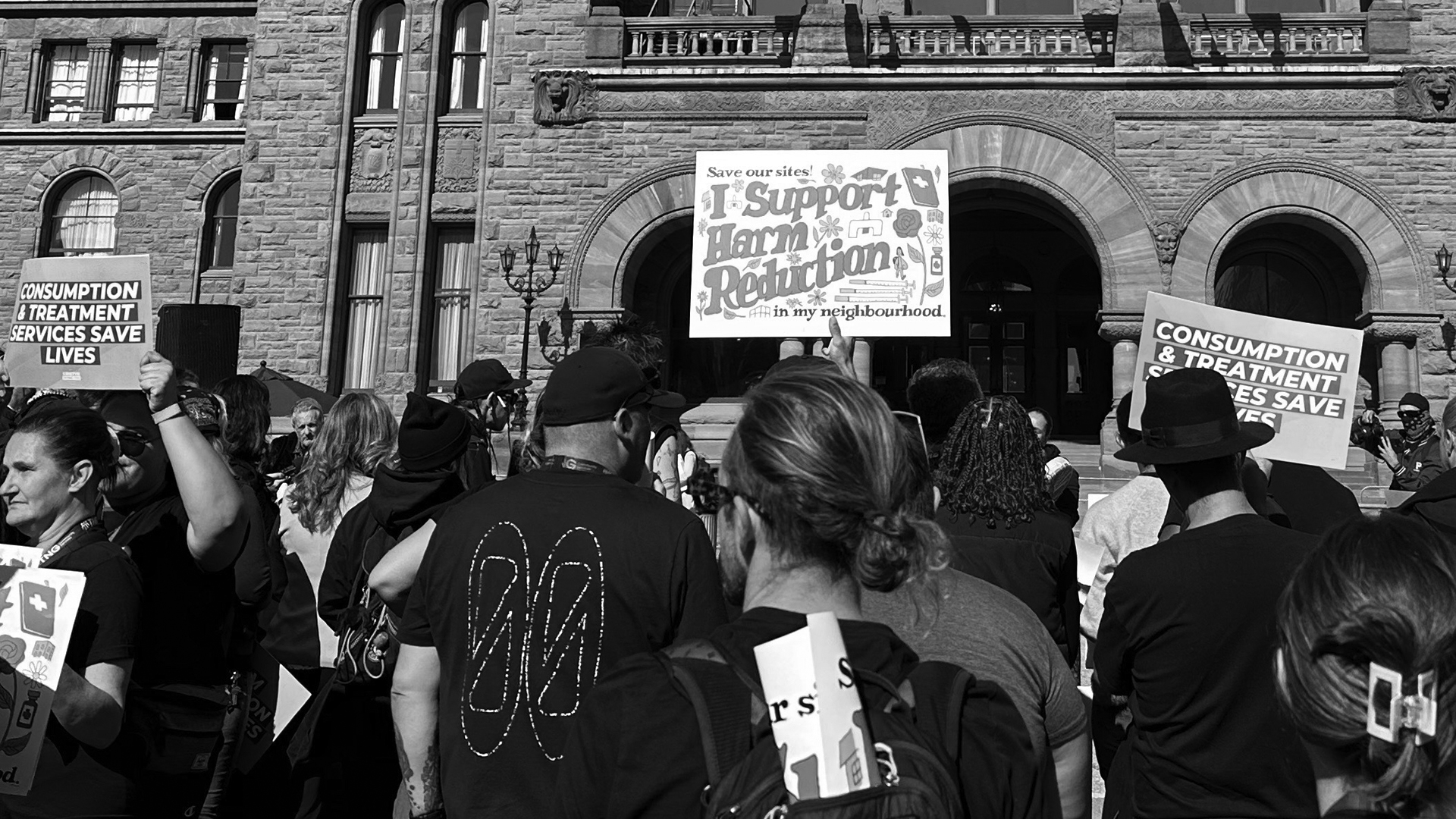
Lessons from compassionate, trauma-informed coverage of substance use, supervised consumption and community health
By: Chloe Kim
If They Close is a 15-minute audio documentary adapted from a graduate research project that examines the impact of Ontario’s plan to close supervised consumption sites. It was completed in March 2025, before the planned closures, and centres the voices of people who rely on these sites while contrasting political and media narratives with on-the-ground reporting. The project highlights the human realities behind a policy debate often dominated by rhetoric and stigma. For journalism educators, the project also demonstrates the value of giving students the freedom to pursue journalism on their own terms, outside newsroom pressures, to see what emerges from slower, more reflective practice.
The work was shaped by reflection on how to report ethically, especially when interviewing people who are both directly affected by the issue and often marginalized in public discourse about supervised consumption sites. I made several specific editorial choices with this in mind: I recorded audio rather than video to limit the risk of unwanted identification; I referred to consumption site clients by first name only to balance transparency and dignity while still protecting some of their privacy; and I offered opportunities for impromptu follow-up interviews, so that participants could decide when and how much they wanted to share.
These choices sometimes meant compromising on production elements that would traditionally be prioritized in a newsroom setting. For example, allowing impromptu follow-up interviews meant not always being ready with the best recording device, which resulted in less-polished audio but respected subjects’ autonomy. Opting for audio-only interviews meant forgoing the visual impact of video, but it aligned with my responsibility to minimize risk for participants who were already vulnerable.
Each decision was grounded in a conscious trade-off between conventional journalistic practice and my aim to report respectfully. My interest in these practices was sharpened by my own experience of being the subject of another audio documentary, The Call, while I was working on this project. The experience of being interviewed gave me a clearer sense of how exposed and uneasy it can feel to hand over one’s story, even when the journalist is well-intentioned. It reinforced the importance of carefully considering consent, anonymity, and the potential consequences of publication.
I also had the time to put those lessons into practice. As a graduate student in the Master of Journalism program at Toronto Metropolitan University, I had nearly a year to develop this project. That flexibility allowed me to experiment and adjust my process in ways that are rarely possible in daily newsroom production schedules, where deadlines limit the ability to prioritize rigorous editorial standards in every step of the reporting process. This highlighted to me the unique role of student work: it creates space to test alternative approaches and to reflect on the kind of journalist one wants to become, even if such approaches are difficult to replicate under typical industry pressures. That freedom underscored to me how important it is for journalism education to create more room for experimentation—not simply to prepare students for industry deadlines, but to let them consider which reporting methods interest them and to try them out.
Throughout the process, I reflected on the tension between journalism’s responsibility to inform the public and the risk of retraumatizing or exploiting sources. Classroom discussions I led as a teaching assistant in a journalism law and ethics course also shaped how I approached these choices. One moment that stands out is when students began their court reporting assignments. Many described how unsettling it felt to approach people involved in court cases during what could be one of the worst moments of their lives. Their discomfort and guilt resonated with me. When I carried out similar reporting excursions for my graduate research project, I tried to do interviews in a way that reflected the kind of journalist I want to be—maybe uncomfortable, but also thoughtful and intentional. While working on this project, I reminded myself that if I was going to ask people to talk about such a personal subject, it had to be entirely on their terms: without pressure, without judgment, and without making them feel that their emotions were a burden, since I was the one stepping into their lives.
Questions such as when to re-interview trauma survivors, how much anonymity to provide, and what constitutes informed consent became active considerations in my process. My project became a way of translating those debates into practice and testing how they play out in real reporting scenarios.
If They Close is both a piece of reported journalism and a reflection on process. It demonstrates how choices around framing, sourcing, and storytelling carry ethical weight, and how those choices can shape the stories that reach the public.
My hope is that this graduate research project will encourage empathy for sources and remind journalists to consider the vulnerability that comes with sharing one’s story. I also hope the project highlights the importance of supporting students as they experiment with different approaches—not only to produce a polished final product, but to empower them to create journalism that lives up to their own standards. For educators, this means recognizing the value of letting students slow down, test new methods, and make editorial choices on their own terms, outside the constraints of typical newsroom production. Supporting that experimentation isn’t just about producing polished work. It’s about cultivating journalists who have a clearer sense of the practices and values they want to carry forward.
Listen to the full audio documentary in the Fall 2025 issue of Facts and Frictions
Facts and Frictions is published by J-Schools Canada, Canada’s national association for post-secondary journalism research and education. All content is open access and available via J-Source.