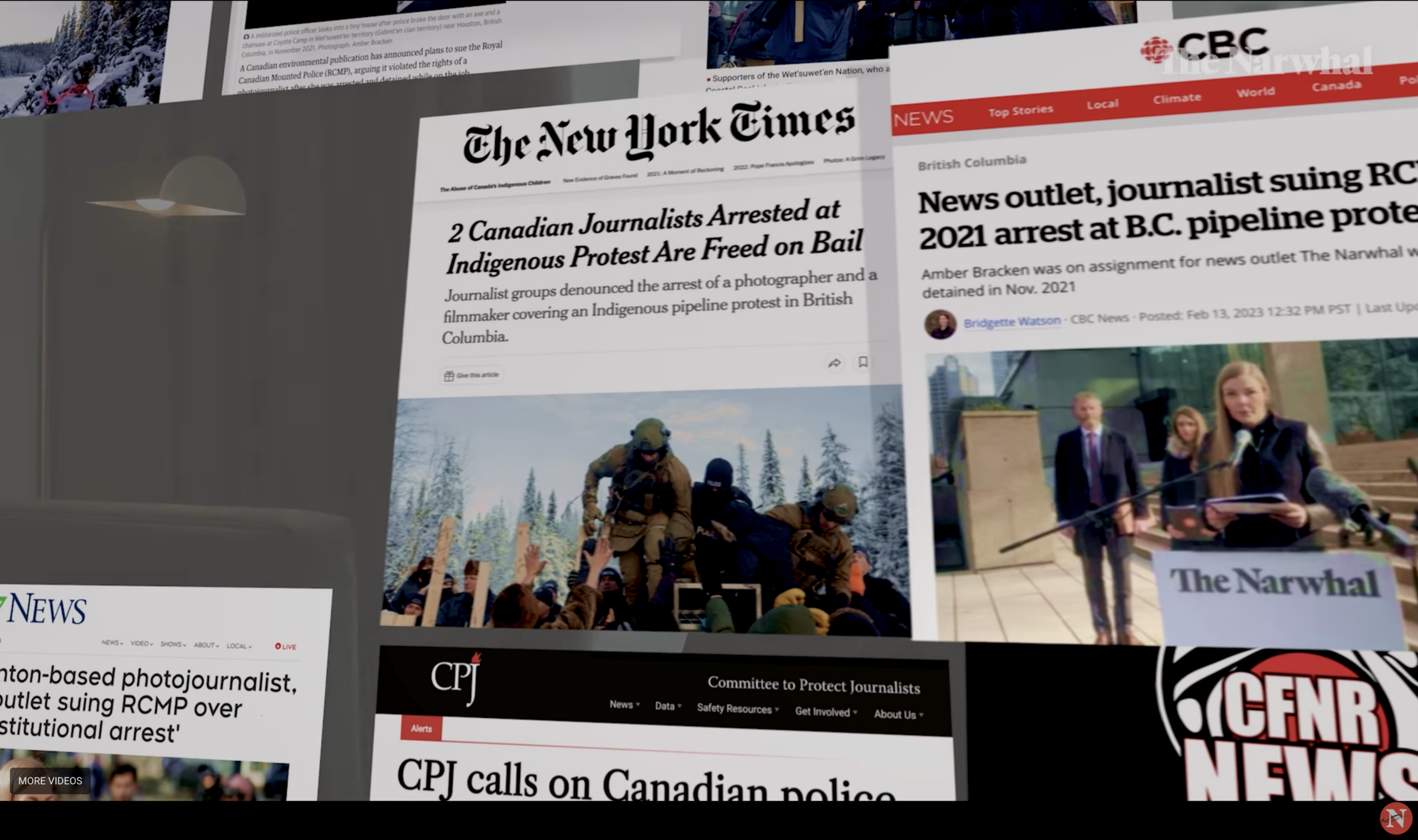
Photojournalist Amber Bracken and publication The Narwhal are suing the RCMP for violating Charter rights. Here’s what you need to know
Photojournalist Amber Bracken and The Narwhal have finished their fourth of five scheduled weeks in court in a significant press freedom case, which aims to hold the RCMP accountable for arresting Bracken in 2021.
“We’re trying to strengthen the protections for journalists out in the field in terms of their dealings with the RCMP, trying to prevent them from interfering with journalists’ work, trying to get clear, clear guidelines and real remedies in place for the RCMP to work under,” Sean Hern, the lawyer representing Bracken and The Narwhal, told APTN.
Narwhal editor-in-chief Carol Linnitt has a quick summary of testimony so far, and the Globe and Mail’s Marsha Lederman also weighed in on the trial’s significance.
A quick recap of the facts: RCMP officers arrested Bracken in November 2021 while she was on assignment for The Narwhal covering protests against pipeline construction on Wet’suwet’en territory in B.C. Documentary filmmaker Michael Toledano was also arrested.
The day before Bracken’s arrest, police arrested journalist and filmmaker Melissa Cox who was also covering protests in Wet’suwet’en territory. The two incidents came after months of similar obstruction at the Fairy Creek anti-logging protests in B.C., where J-Source’s Canada Press Freedom Project recorded at least 19 separate incidents of police interfering with media workers, including one arrest.
Bracken (a CPFP advisory board member) was photographing inside a small cabin where protesters had barricaded themselves. Police broke down the door and pointed rifles at Bracken during the arrest. She was handcuffed and detained for three days, and had her gear confiscated, preventing the publication of her photos until after she was released.
Some of her gear was later found abandoned under a pile of rubble in the protest camp, which had been bulldozed by police.
The court has so far heard extensively from Bracken, who gave more than 12 hours of testimony, as well as journalism experts and other working journalists talking about, among other things, journalism best practices and legal issues when reporting from injunction zones.
Among other accusations, the RCMP have suggested that Bracken didn’t do enough to identify herself — a theory contradicted by a large volume of evidence showing that RCMP knew who Bracken was and knew she was covering the protests.
Narwhal editors had spoken with police, and Bracken was carrying a press pass and assignment letter. She also identified herself to police when they entered the barricaded home. Police records also show that they had been tracking Bracken.
The Narwhal is posting updates from the trial on their website.
And for even more details, photojournalist Camilo Ruiz has been providing an exhaustive daily account — including evidence from journalism advocates, the ins-and-outs of the RCMP’s winding arguments and odd bits like the creepy song used by RCMP officers to jam the radio communications of protesters.
Ruiz also provides context and insight from his time covering the Fairy Creek protests, where RCMP routinely blocked access and interfered with media workers.