
From extraction to exchange: let’s get the full picture from journalism
By Saranaz Barforoush, Paula Carlson, Michelle Stack and The Shift — Local Journalism Initiative — Megaphone Magazine
Trust in journalism is eroding worldwide, with fewer people believing the news they consume. According to the Reuters Digital News Report 2024, only 40 per cent of people globally say they trust “most news, most of the time.” In Canada, the figure is slightly lower at 39 per cent, but it is on a downward trend.
Researchers say people are frustrated because many news sources seem biased or don’t tell the whole story. Social media platforms such as Facebook and X don’t help. Less than one-quarter of users trust the information they read on these sites.
This matters, because as trust in journalism drops, it gets harder for people to have conversations about the issues affecting their lives.
This distrust is especially understandable in communities like Vancouver’s Downtown Eastside. People in the media often portray the DTES as a broken place that needs help from people outside to “fix” it. This kind of reporting misses key context for understanding this vibrant and complex neighbourhood.
For example, Indigenous communities were forced off their lands and many continue to be unhoused. Chinese settlers faced exploitation and exclusion. During the Second World War, Japanese-owned businesses and homes were taken away by government. The Black community was also pushed out to make way for the Georgia Viaduct.
Today, issues such as deepening poverty and inequality, punitive city and police policies, inadequate affordable housing, an ongoing toxic drugs crisis, and a lack of meaningful supports around mental health and substance use continue to harm residents.
These factors necessitate a trauma-informed approach to reporting, as well as having a basic knowledge of the history and issues of the community.
Does the DTES have challenges that need to be reported? Of course. It would be a disservice to everyone not to. But framing the area as “the problem” ignores the fact that these are issues that affect many of us in one way or another. While concentrated and more visible in the DTES, they don’t originate in the DTES. Presenting it otherwise may actually encourage inhumane solutions — such as heavy-handed street sweeps or worse — while missing how the community comes together to care for each other and fight against these issues, which in turn, benefits everyone.
Changing the narrative on poverty
In early 2023, when the University of British Columbia called for proposals to fund innovative student learning projects, it opened the door for a special collaboration.
Megaphone was able to team up with UBC journalism students and the UBC Learning Exchange (UBCLE) to embark on important work. The collective goal? Spark an in-depth conversation about how mainstream media reports on vulnerable populations and how community members can better engage with journalists.
The project also aimed to explore how current journalism students learn about the DTES, and would eventually seek to inform schools and newsrooms on best practices when reporting on marginalized communities.
The unique aspect of the project was placing people with lived experience at its centre.
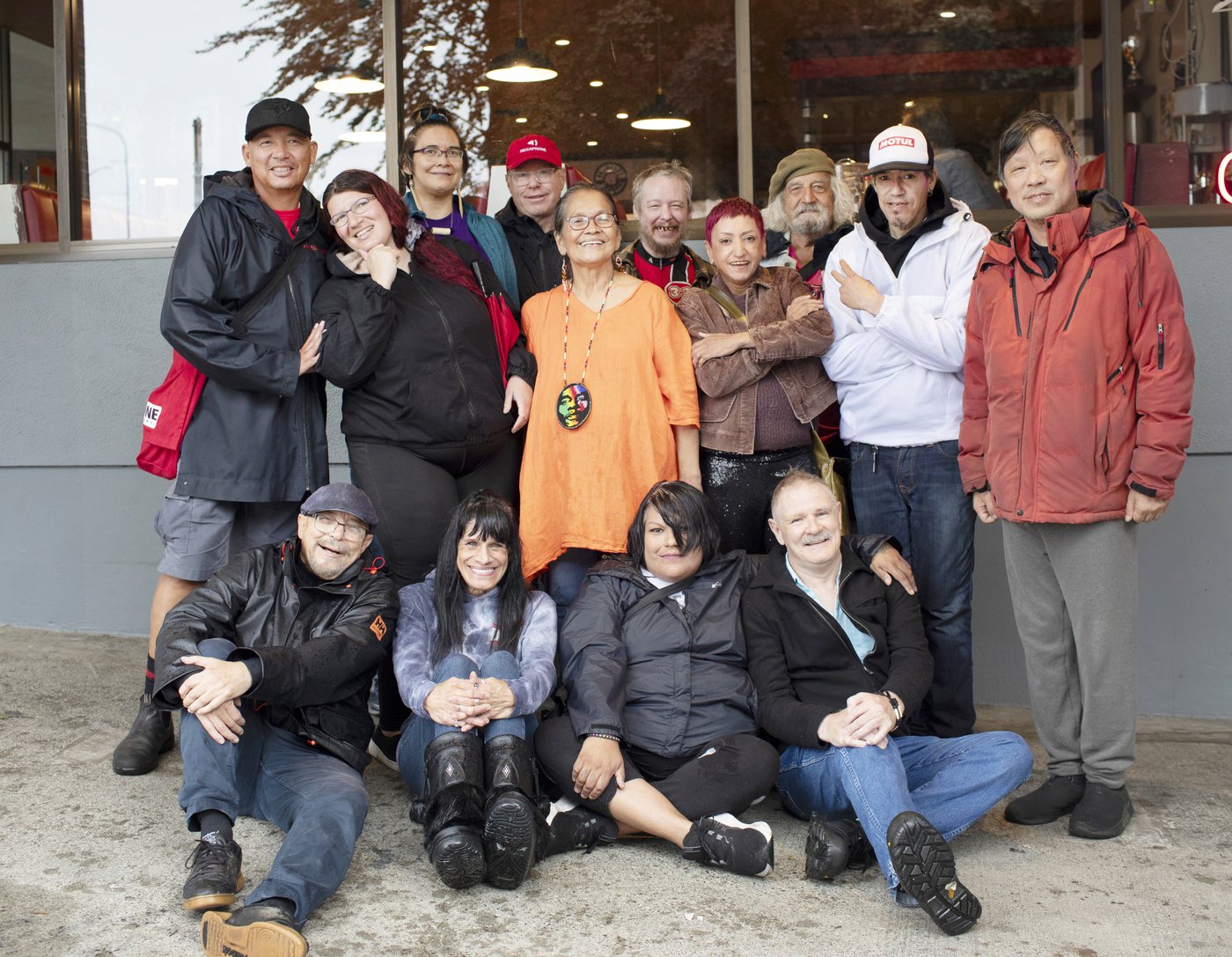
Enter The Shift, Megaphone’s peer newsroom — a group of community writers and photographers with direct experience of the very issues frequently reported on by media.
These peer reporters bring a distinctive perspective to the table: by living and working in the DTES, and actively producing a monthly magazine at Megaphone, they are both reporters and the reported on. They understand the pressure of a deadline, and know what it feels like to be misquoted or dismissed.
Diversity in action
Amplifying voices that are too often ignored is nothing new to Megaphone. When the magazine launched in 2007 — taking over from street papers Spare Change and Street Corner, which had been sold on Vancouver’s streets since 1992 — it modelled for media outlets how to shift the frame from extractive, sometimes sensational journalism, to respect for the insights of marginalized residents.
Megaphone magazine’s pages are filled with the perspectives of its low-income vendors, writers, artists and photographers.
And since 2021, peers who have completed journalism training have been contributing quality, award-winning journalism to every edition.
The Shift was launched in early 2023 and is one of the most diverse newsrooms in the country. It includes more than a dozen individuals who are informed by their direct experiences with poverty, homelessness, substance use, physical disability, mental illness, incarceration, racism and immigration, as well as their Indigenous, racialized and 2SLGBTQI+ backgrounds.
Its work appears across the country as part of the Local Journalism Initiative, and as a member of the International Network of Street Papers, Megaphone joins publications all over the world that subscribe to the same mission: changing the narrative on poverty and homelessness by empowering low-income individuals and amplifying their voices.
Fostering a paradigm shift
But there is much more that could be done. How can we improve the coverage by large mainstream media outlets of underprivileged communities such as the DTES? News stories matter because they influence government policies and practices, and whether the public ultimately supports or opposes them.
On the ground, how stories are made matters, as real harm can be inflicted on vulnerable populations when individuals are misquoted, misrepresented or dismissed.
This raises the issue of media literacy. How can we empower marginalized individuals to be better equipped when reporters come calling?
To address this, starting in 2023, The Shift, UBCLE and UBC students in the Masters of Journalism program embarked on an in-depth series of workshop sessions spanning 18 months, funded by UBC’s Teaching and Learning Enhancement Fund.
The group took deep dives into topics such as journalism ethics; trauma-informed reporting; Indigenous perspectives on journalism; fact-checking; story framing; how to talk to a journalist; media handling; and much more.
The monthly sessions involved robust discussion, hands-on exercises and instruction from journalism professors and special industry guests — including CBC Indigenous Affairs Reporter Wawmeesh Hamilton and Carleton University Assistant Professor Matthew Pearson, who is a leading expert in trauma-informed journalism.
The Shift members worked alongside the students — who also helped facilitate workshops — wrestling with big questions such as, “Is it OK to share a story with a source before publication? Is it fair to take a photo of someone on the worst day of their lives? What if they give consent but are high on drugs? How do you present a true picture while minimizing the potential for harm?”
At the end of the workshop series, The Shift members continued to meet regularly, drawing from their lived experiences and community knowledge to create a living document: Shift Happens — A Media Guide for Journalists Covering the Downtown Eastside.
It consists of two parts: a Code of Ethics for journalists to consider when reporting on marginalized populations, and a Bill of Rights for neighbourhood residents and organizations so they can be better informed when they are asked to be a source for a story.
Journalism that gives as well as gets
This initiative was inspired by important earlier work done by DTES peers, including Research 101: A Manifesto for Ethical Research in the DTES, a Simon Fraser University initiative which stipulated that people in the community be properly acknowledged and respected for their contributions to academic research.
Several current members of The Shift took part in that project and wondered: What would the principles of Research 101 look like if applied to journalism?
The Shift’s guide was also heavily influenced by the Society of Professional Journalists Code of Ethics.
The guide offers suggestions, some of which go against current journalism norms — such as sharing parts of stories with sources before publication or paying some form of compensation for people’s time and expertise.
Is it perfect? No. One of the things we learned through the process was that there are no one-size-fits-all answers; context matters, especially the realm of power… who has it, who doesn’t and how sharing it can actually improve journalism.
So these guidelines are not an end product — they’re part of an ongoing discussion between journalists, editors, publishers, communications professionals, educators, organizations and people in the DTES. It’s less a code of ethics and more an invitation.
If anything, it’s encouragement to explore a new approach to reporting, a kind of “reciprocal journalism” which prioritizes long-term respectful relationships between journalists and community members working together to tell truthful stories.
This can promote solutions-based journalism, which in addition to investigating “what’s gone wrong,” explores how people can work together to solve problems.
Megaphone illustrates this approach. Through its vendor program and writing/photography workshops, the non-profit has created a space where journalism becomes a tool for community building rather than just information delivery. These initiatives demonstrate that when people have agency in telling their own stories, it produces more accurate and nuanced reporting and helps repair the broken trust between media institutions and the communities they report on.
Are there risks to approaching journalism this way? Sure. But as we have seen, there are serious consequences to not approaching in this way. In practice, what peer reporters have found is that most of the reporting actually gets better.
What’s next?
Journalism now stands at a crossroads. Educators must prepare future journalists to listen, understand and ethically engage with communities. That means teaching historical context, cultural sensitivity and trauma-informed principles.
This project — part research, part pedagogy, part media intervention — asks that the DTES community, journalism schools, researchers and media outlets build on this guide. Debate it. Share it. Collaborate across community organizations, campuses and newsrooms to do journalism that is rooted in respect and relationships.
Journalism doesn’t have to fall into stereotypes, misinformation or disinformation. The Shift and the journalism students involved in this project show clearly that another kind of journalism isn’t just possible — it’s already occurring.
Shift happens!
We’d love to hear your feedback. Drop us a line at info@megaphonemagazine.com
ARE YOU READY FOR THE SHIFT?
Should there be a set of guidelines for journalists to consider when reporting on the Downtown Eastside to minimize harm?
Reporters in Megaphone’s The Shift peer newsroom think there should be.
So they made one:
SHIFT HAPPENS — A Media Guide for Journalists Covering the Downtown Eastside
ABOUT THIS GUIDE
Shift Happens — A Media Guide for Journalists Covering the Downtown Eastside has been created by members of Megaphone’s The Shift peer newsroom, a group of more than a dozen people who have lived experience with poverty, homelessness, substance use, physical disabilities, mental illness, incarceration, racism and immigration, as well as Indigenous, racialized and 2SLGBTQI+ backgrounds. Our peer reporters are not only active members of the Downtown Eastside (DTES), they have also undergone basic journalism training — many as part of a scholarship program in Langara College’s journalism department. This makes The Shift uniquely equipped to offer their expertise for this project, as they are both reporters, and the reported on.
Shift Happens is the result of a series of workshops and working groups that took place over 18 months.
It is supported by Megaphone, the University of British Columbia School of Journalism, Writing and Media, and the UBC Learning Exchange. Participants took deep dives into ethics; trauma-informed reporting; Indigenous perspectives; fact-checking; story framing; how to talk to a journalist; media handling; and more.
There are two main parts to this guide: a Code of Ethics – For Journos and a Bill of Rights – For Sources. These principles recognize the power imbalance that exists between media and marginalized populations, and aim to level that inequity through the sharing of knowledge and dialogue. It is not a set of rules; it is a collection of recommendations — rooted in real life experiences and designed to make storytelling in vulnerable communities a less harmful, more accurate endeavour for all. Is it perfect? No. We learned there are few hard-and-fast rules and that context matters. This is a starting point for an ongoing discussion about how to better report on communities like the DTES.
This is a living document — a work in progress that will grow and change with updates from The Shift, working professionals, non-profit service providers and marginalized people — everyone who is directly impacted by media. The hope is that journalists, editors, publishers, communications professionals, educators and organizations utilize this as a call forward — to think about who is present and who is absent in telling a story, and which stories are being missed.
CODE OF ETHICS — FOR JOURNOS
- Be trauma-informed
- Learn about and understand what trauma is and how it can affect the reporting process and memory.
- When reporting about trauma, always consider how systems contribute to and perpetuate it.
- Ensure the subject’s needs for a sense of control, agency and safety is prioritized throughout the process.
2. Get ongoing, informed consent
- The DTES requires a special kind of consent. Be clear. Be generous. Be kind.
- Consider that this isn’t just “your” story, but a collaboration with your subject(s).
- Yes, you can share quotes, parts of the story, or even the entire story before publication. This can improve accuracy and foster trust with people who are not used to telling their story.
- Unpack how stories could impact sources, such as reactions from family, friends, housing providers, police and employers.
- Offer rolling consent so that individuals can withdraw permission at any time along a mutually agreed-upon timeline (i.e. up to publication deadline).
- Remind sources at key points that they have the choice to answer individual questions and/or continue participating.
- Be transparent about all the ways the information could appear, from websites to social media, radio, television and so on.
- If a source appears to be in an altered state of mind, try to return to them before publication to confirm consent. If you know this person well and are on a tight deadline, use your best judgment.
- Be aware of cultural differences and language barriers.
3. Minimize harm
- Be accurate. Fact-check the stereotypes. There are a lot of stereotypes.
- Be a wise guardian of stories. You are privileged to have certain information and know how the media works. Treat this awareness with care and understand how it may impact people.
- Check your ego. Be transparent about the knowledge and background you have in the DTES.
- Don’t make promises you can’t deliver. Journalism has its limitations. While it’s possible a single story can lead to significant change, it’s also possible it could have other unexpected outcomes or no impact at all.
- For more in-depth features or profiles, consider preparing sources for what can happen after publication and then check in with them after.
- Inform sources that there are options to protect their identity if they wish.
4. Source better
- Don’t always talk to the same sources. The DTES doesn’t speak with one voice.
- Official sources are not always right. Be as skeptical with them as you are with anyone else.
- Also ask people in the DTES who they trust. Seek sources from community organizations and individuals with direct experience of the issue.
- Be aware of how your positionality influences who you do and don’t include.
- Be mindful of bias against stigmatized groups, such as substance users and sex workers.
5. Frame responsibly
- While the DTES may have serious challenges, remember that it is also a close-knit and caring community rich in history and culture that people call home.
- Resist “needle-in-the-puddle” imagery. Sensational photos are powerful but often don’t tell the whole story.
- Watch how your language, layout, headline and photo placement choices may reinforce stereotypes.
- Identify people the way they want to be identified. Style guides and consistency are important tools for clarity and understanding, but not everyone agrees with their recommendations. For example, people who have substance use disorder often identify as “addicts” as part of their healing journey, or Indigenous Peoples may in some cases wish to refer to themselves as Native.
- Don’t always focus on the problem. Consider practising solutions-based journalism as well.
6. Acknowledge inequities, large and small
- As a journalist, know that you have more power than you think. Many in the DTES see you as an authority figure.
- Recognize and report on the historical and systemic contexts that underlie the complex challenges that surface in the DTES
- Consider how your own positionality informs your views. Be open to hearing about your own blindspots. It will make you a better journalist.
- Use quotes responsibly. Are you running with something for purely sensational reasons?
- Use small, practical steps to help people feel comfortable while maintaining clear professional boundaries.
- Consider offering compensation for people’s time. Paying for time is not the same as paying for a story. We know this has risks. We also know that not paying for people’s time could mean that certain perspectives may be missed. Without those voices, you may not have a balanced story.
BILL OF RIGHTS — FOR SOURCES
Before the interview
- Know your rights
- You can refuse to do an interview at any time, even if you initially said yes.
- You can ask to review your quotes before they are published.
- You can ask for a correction to be published or broadcast if your words are taken out of context.
- Your well-being comes first; you have the right to protect yourself from further harm or trauma.
2. Inquire about the story’s purpose and sources
- What is the angle of the story? How will it be framed?
- Ask why the reporter is interested in speaking with you specifically. Have they also reached out to community organizations or people with direct experience of the issue?
- Who else will be included in the story? Are they including a diverse range of voices from the DTES, such as Indigenous Peoples, 2SLGBTQI+ communities or people with disabilities?
3. Ask questions
- How long has the reporter been covering stories in the DTES or similar communities? Are they aware of their own biases when reporting on marginalized communities, and if so, how do they plan to address them?
- Will they be considering the context around systemic issues (such as poverty or colonization) in their reporting?
4. Request identification and credentials
- Ask for the journalist’s name, contact information and the media outlet they work for.
- Do they have press credentials or a business card? At the very least, get a phone number or email.
- Exercise caution when working with publications and journalists from outside of Vancouver. If they act unethically or publish inaccurate information, it may be difficult to seek a remedy.
5. Decide on anonymity and boundaries
- Clearly state if there are topics you do not wish to discuss. Be specific about the areas that may trigger trauma or cause distress.
- You can request anonymity or use a different name to protect your identity. Set these expectations upfront.
6. Understand trauma and its impact
- Ask the journalist if they have experience with trauma-informed reporting and how they plan to handle sensitive topics.
- Know that trauma is related to a lack of control over distressing situations and a lack of support afterward.
You have the right to set the pace and topics of the conversation.
During the Interview
- Reiterate your boundaries
- Begin by reminding the journalist what you are comfortable discussing and any off-limit topics.
- If they move away from agreed-upon subject matter, you can steer the conversation back or refuse to answer.
2. Bring a support person
- You can have someone you trust present during the interview, especially if it regards a traumatic experience.
They can take notes, provide emotional support and help you stay grounded.
- Lead the conversation
- Set the tone and pace for the conversation. Share only what you feel comfortable sharing. Journalists should be patient and not rush you.
4. Pause, breathe and check
- At any point during the interview, you have the right to pause and check in with yourself. Take a moment to breathe and assess how you feel. You can suggest that the journalist to do the same to maintain a safe and balanced interaction.
5. Take notes or record the interview
- You can record the interview on your phone or ask your support person to take notes. Let the journalist know you’re doing this.
6. Stop the interview if uncomfortable
- If you feel pressured, unsafe or uncomfortable at any time, you have the right to pause or end the interview. There is no need to provide a reason.
7. Maintain control over your story
- If a question feels leading or biased, ask the journalist to clarify or rephrase it. Don’t let them shape your story.
After the Interview
- Request to review quotes
- Ask if you can review the quotes or parts of the story to make sure everything is accurate and in context.
This can help prevent misrepresentation and build trust.
- Follow up for clarification
- If you feel worried about any aspect of the conversation, reach out to the journalist to clarify or correct information you provided. Have your notes or recordings handy to back up your request.
3. Request a copy of the published story
- Ask when and where the story will be published. Request a link or copy to see once it’s available.
4. Check in
- After the interview, check in with yourself, a trusted person or an organization to debrief. It’s OK to seek emotional support.
5. Hold journalists accountable
- Be aware of the power imbalance between journalists and the DTES community. This affects how stories are framed and whose voices are prioritized.
- If a journalist has breached your trust or misrepresented you, reach out to them or their editor. If there is no response, or an inadequate reply, consider filing a formal complaint with their news organization or the National NewsMedia Council, which handles public complaints about news ethics for its members.
6. Understand journalism’s limitations
- Be aware that journalism has its limitations. A story may not lead to significant change or could have unexpected impacts.