
Human rights inquiry finds transparency was “compromised” and recommends funding rights-based training for police
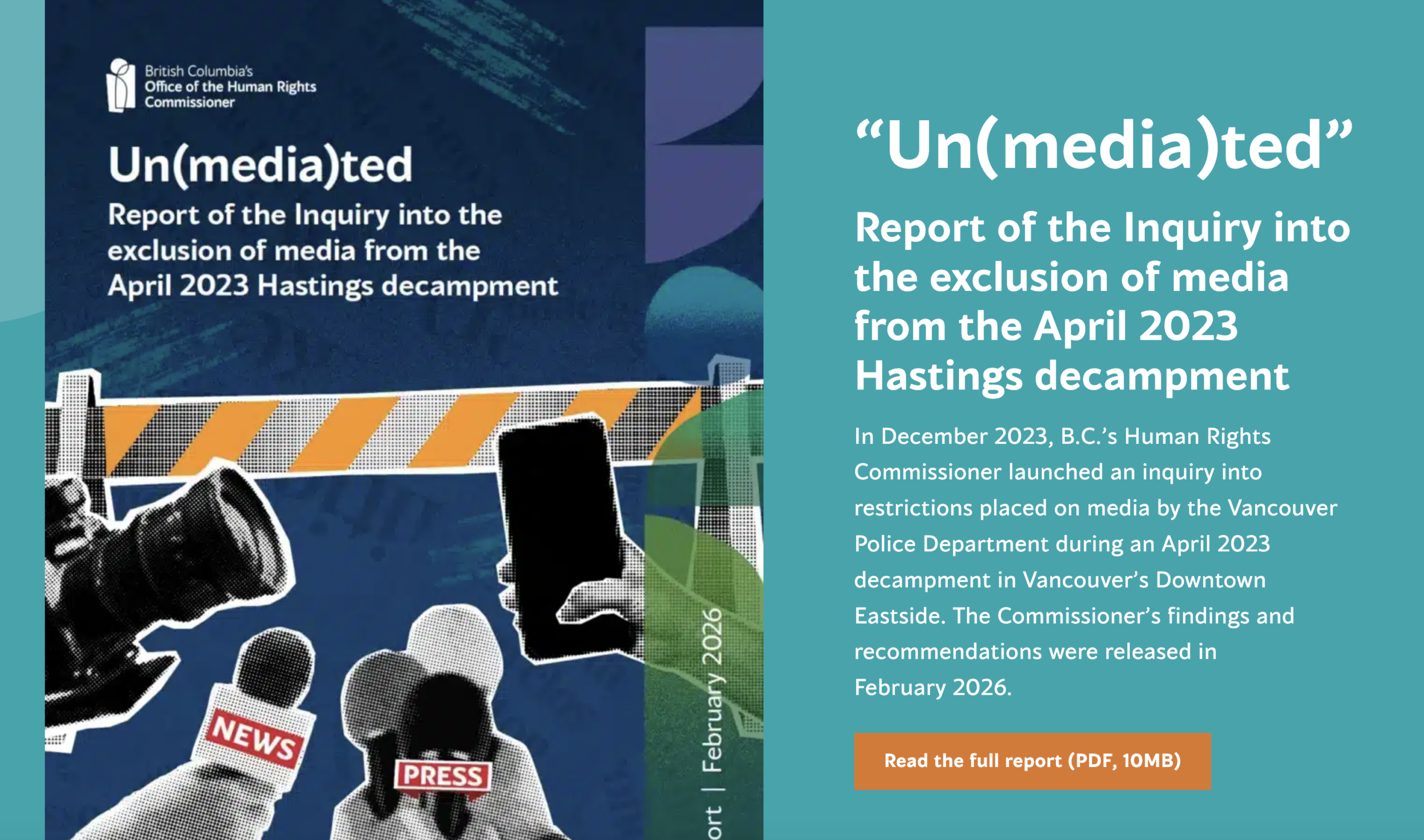
A B.C.’s Office of the Human Rights Commissioner report released Feb. 4 examines how police and city officials made the decision to block media access while they evicted people from an encampment in Vancouver’s Downtown Eastside in April 2023.
The report examines how police and city officials made the decision to ban media, how it played out on the ground and the implications for transparency and democracy.
The BCHRC launched the inquiry in 2023 after Vancouver police denied access to journalists over two days while evicting people living in a Hastings encampment.
(Disclosure: Members of J-Source’s Canada Press Freedom Project masthead participated in a consultative roundtable hosted by the commissioner. The final report also cited J-Source reporting on exclusion zones and CPFP data.)
In short: although the commission didn’t find excluding media appeared to be the purpose of the exclusion zone, BCHRC found police “imposed restrictions on media with little regard to the impact on freedom of the press”, compromising transparency and violating human rights standards.
Here are a few key points from the report:
In general, BCHRC noted the use of similar media restrictions is growing and appears to be spreading from police to other authorities, like park rangers and municipalities — “mutating,” as one journalist witness put it.
The report also notes that exclusion zones have “a long and inequitable history of being used to stop Indigenous people from asserting land rights.” CPFP data also reflect this reality: although they are becoming an increasingly common tool, exclusion zones have mostly been used by police during Indigenous land defence protests.
In Vancouver, the exclusion zone created a lack of transparency with a disproportionate effect on marginalized people in the encampment — particularly Indigenous people and people with disabilities — and “perpetuated systemic discrimination.”
In the face of significant visual evidence and testimony, Vancouver police officials have continued to insist that there was no exclusion zone, and that media were never denied access in a meaningful way.
Police and senior bureaucrats from city departments including Engineering and Arts, Culture and Community Services said the exclusion zone was needed to keep journalists and the public safe and protect the privacy of people in the encampment. BCHRC bought neither of those claims.
In making the decision to exclude media, the VPD commander in charge of the eviction considered “reputational risks” and how coverage would “affect the public’s view” of the police, the city and provincial government. BCHRC said media restrictions “cannot be justified” on those grounds.
Police allowed a single pool camera operated by Global News to access the restricted zone — an arrangement which “shocked” many journalists quoted in the report. BCHR described this as an “unusual arrangement that appeared to prioritize police control rather than media independence.”
Explaining the decision to block all but a pool camera, a VPD media officer compared the situation to media arranging a pool for an overseas trip on the PM’s plane. BCHRC: “With respect, it is difficult to see how these situations are analogous.”
BCHRC also found the police board “abdicated its legal responsibility to properly investigate” a complaint about the incident, describing the investigation as “deeply flawed.”
In response to the complaint, the Vancouver Police Board assigned the task of investigating the incident to the same commander who oversaw it — a decision the BCHRC described as “perplexing.”
The police commander in question — then-Superintendent Don Chapman — “told the Commissioner that he essentially did not do any investigation into the complaint about the creation of an exclusion zone.”
In investigating his own operation, he didn’t involve anyone else at the VPD, didn’t interview any journalists present and appears to have done no research. He did none of this, he said, because he believed the “exclusion zone never took place” and was “something fictitious.”
The Police Board also asked the commander no follow-up questions, spoke to no witnesses – not even the person who filed the complaint – and looked at no documents. After hearing only from the commander, they recommended that the complaint be dismissed.
The Police Board “took no steps to investigate the complaint beyond assigning the task to someone who was clearly biased,” BCHRC said. It was “at best an absurdity and at worst a perversion of justice,” the commission said.
The report made several recommendations; police and municipal authorities in BC should stop blocking media without court authorization, or absent a threat to public safety or to protect a criminal investigation.
BCHRC also recommended that the government pass a law to stop restrictions on media access without court authorization or a genuine reason, codify what kind of restrictions can be introduced and add training for police and improve investigations of alleged misconduct.
Are you a media worker who has been prevented from accessing an area to report, or otherwise had authorities interfere with your work? Contact CPFP to have the incident documented and improve our collective understanding of threats to press freedom.