
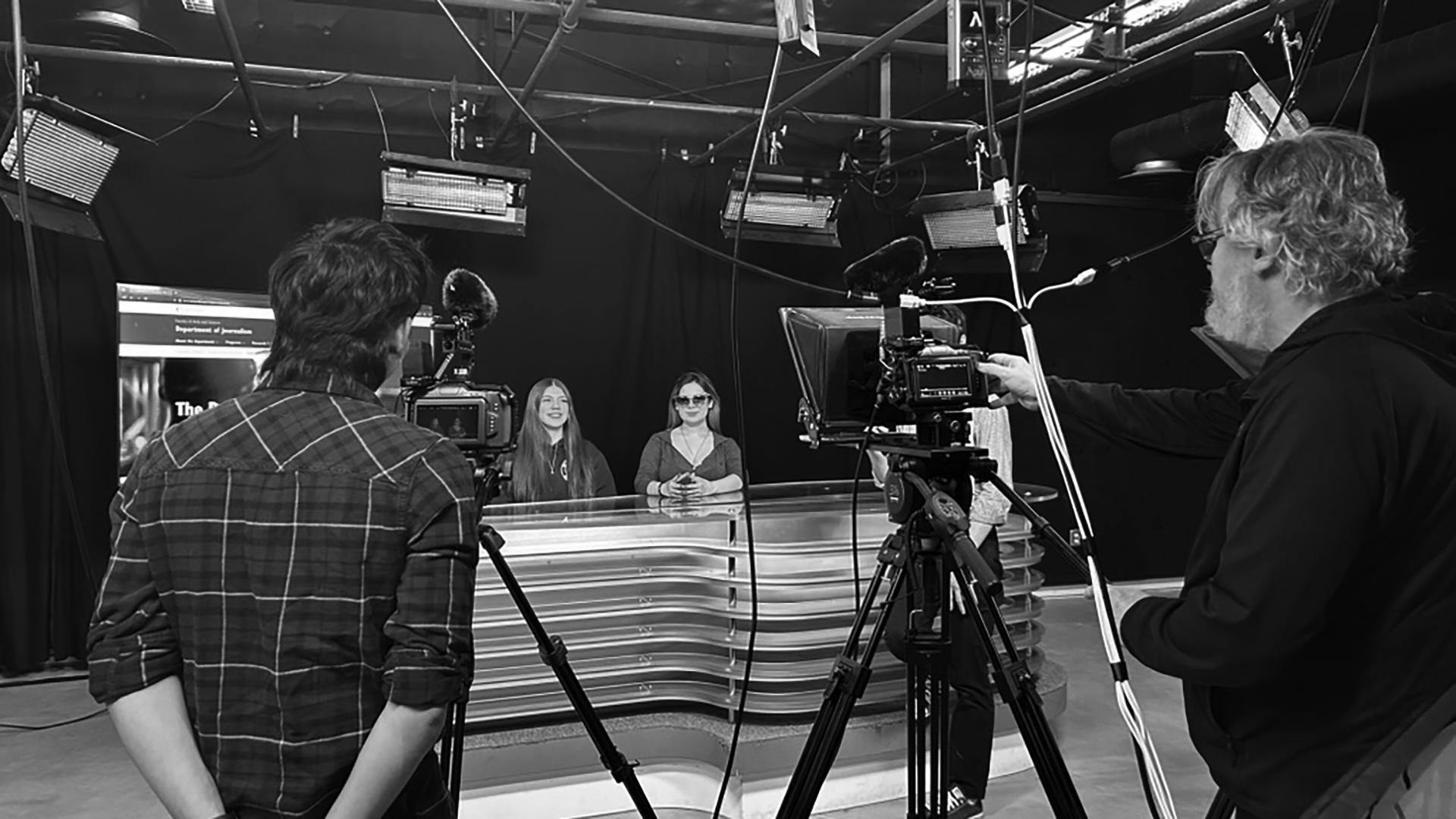
The Concordia University-Kahnawà:ke Survival School collaboration
In a warmly-lit Grade 11 classroom in Kahnawà:ke, two groups of students settle down to work. They scrape chairs across the floor and flip open laptops at tables placed in a large U-shape. Purple and white flags representing the Haudenosaunee Confederacy and Two-Row Wampum hang on the wall, beside a poster showing men wearing traditional feathered headpieces known as Kastowas. There is some chatter, but the students quickly get down to business. This isn’t just a high school classroom; it’s also a working newsroom and the students are on a deadline.
The KSS Newsroom project launched in Fall 2022 as a partnership between Concordia University’s Department of Journalism, Kahnawà:ke Survival School (a secondary school in nearby Kahnawà:ke), and CBC Montreal. The aim of this Indigenous-led project is to introduce journalism to Kanien’kehá:ka youth as a potential career option, while educating non-Indigenous journalism students on the importance of respectful practices and relationships in working with Indigenous communities. The Concordia journalism students work with KSS students—usually in Grade 11—over several weeks as they produce audio and video stories about their community, for publication or broadcast by CBC. Working in collaboration, the two groups of students have also produced six digital stories for the CBC Montreal website. However, it is the short, 2-3 minute stories for broadcast or podcast which have proven optimal in this context as they are relatively simple to produce but provide a substantial pedagogical impact. This article features three stories created through the collaboration: one digital, one audio, and one video, all produced by Kahnawà:ke youth, supported by Concordia journalism students.
Read the full article in the Spring 2026 special issue of Facts and Frictions
Facts and Frictions is published by J-Schools Canada, Canada’s national association for post-secondary journalism research and education. All content is open access and available via J-Source.