
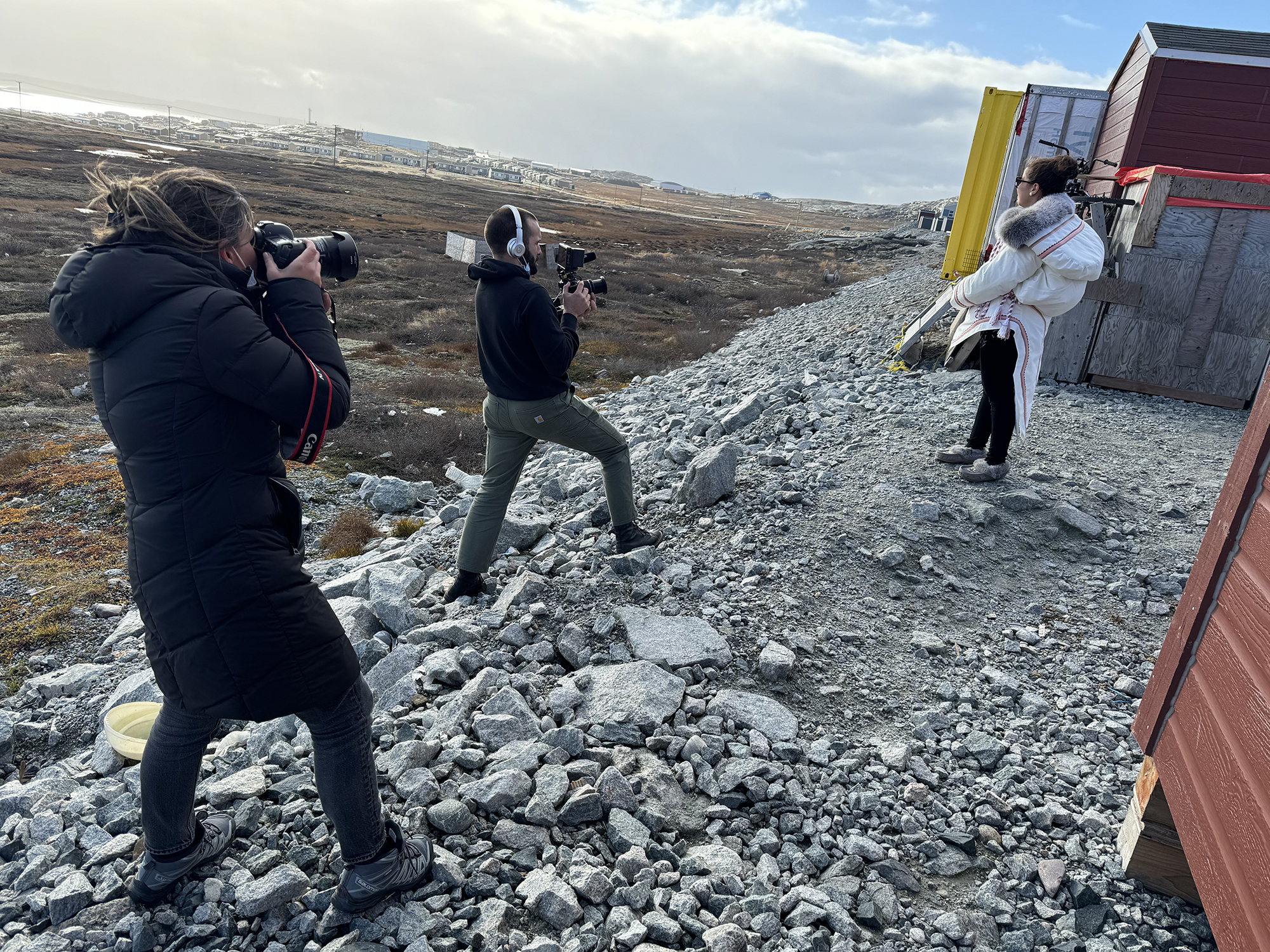
The Flowing River documentary explores both the run-of-river hydro project that now powers the village of Inukjuak in Nunavik, and the relational flow of journalism that emerges from reciprocity with Inuit climate leaders
In a rapidly changing and polarized world, the question of how to practice ethical journalism has become increasingly complex. Notably, the concept of objectivity in the Western tradition has been challenged by theories of “trust-building, identity and care” that encourage journalists to acknowledge their own identities, privileges and biases for more engaged coverage (Robinson, 2023, p. 91). When these approaches are discussed, especially within the context of reporting in marginalized and underreported communities, the conversation is often laced with tension between traditionalists who think journalists must always remain impartial and detached, and others who believe it is possible to do journalism while situating themselves as allies (Patching & Hirst, 2022; Munno & Craig, 2020). On the former, Tuck and Yang (2012) describe “settler moves to innocence” as ways settlers distance themselves from colonial harms without giving up power; a parallel can be drawn here to the appeals of traditionalists to neutral objectivity (p.10). Additionally, Usher (2019) calls this pattern “defensive professionalism” where time-honoured norms in the field make it difficult for industry leaders to recognize or even adapt to change (p. 142). Against this backdrop, Wallace (2019) outlines a broader application of ally-informed reporting in A View from Somewhere, exploring “how journalists can resist the objectifying, extractive model of journalism, while holding to our role as purveyors of truth in the world” (p. 205).
ᑰᒃ ᑰᑦᑐᖅ The Flowing River, a 19-minute documentary, explores both the run-of-river hydro project that now powers the village of Inukjuak in Nunavik, and the relational flow of journalism that emerges from reciprocity with Inuit climate leaders. For more than two decades, these leaders have worked to transition their community from diesel dependence to clean renewable energy, in a context where Inuit are disproportionately impacted by Arctic climate change and their “right to be cold” is increasingly threatened (Watt-Cloutier, 2015). The film shares their story through their own language, voices and perspectives. This essay situates the documentary within journalism theory and ethics to demonstrate how an engagement approach can challenge long-standing concepts of objectivity, from the 20th century norm that journalists should report “only the facts” (Schudson, 2001), to later views of objectivity as a process of verification rather a claim that a reporter is fundamentally neutral (Kovach & Rosenstiel, 2021). McCue’s (2023) work on decolonizing journalism shows how negative, stereotypical reporting about Indigenous communities has eroded trust in journalism, but it also offers a practical roadmap centred on relationship-building and reciprocity (p. 13), principles this essay examines through an engagement-driven approach to documentary work.