
Digital reach not enough to stop five Black-owned publications from going offline
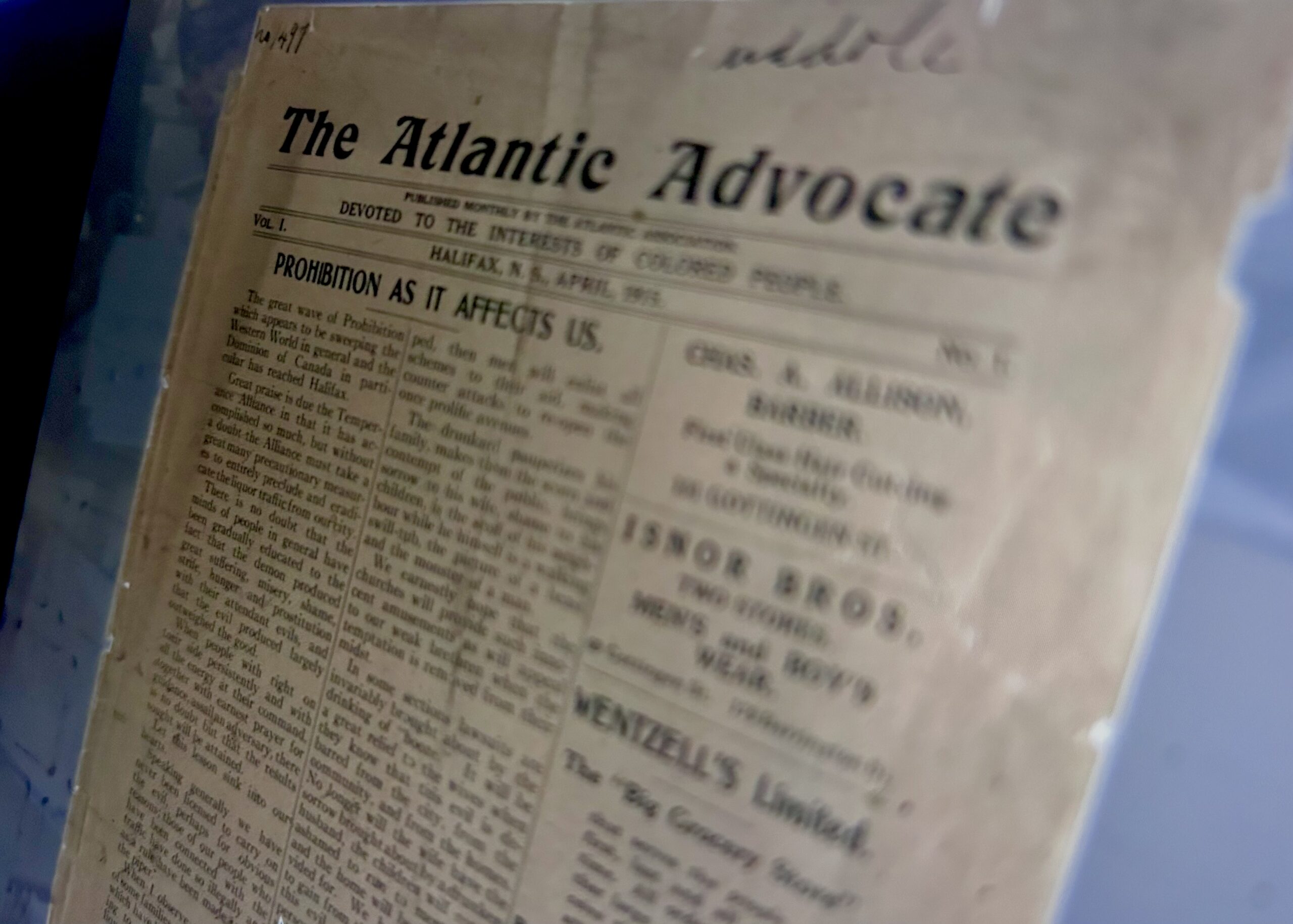
Black-owned publications have been referred to by communications scholar Tokunbo Ojo as “safe nests” from media misrepresentation, under-representation and invisibility. Unfortunately, those nests have collapsed in some of the smallest and most geographically fragmented Black populations in the country, according to a study out of the University of King’s College in Halifax.
At least five Black-owned publications have folded in Atlantic Canada since 2022. A media ecology analysis has found that these outlets had small subscriber bases, limited sponsorship, and YouTube footprints below the platform’s revenue threshold.
Meanwhile, nine other Black-owned outlets in the four eastern provinces remained active as of July 2026, with most displaying active revenue streams and consistent, community-centred content that included journalism.
The Atlantic Research Lab at King’s is conducting a five-year study into the challenges and opportunities facing media outlets owned by Black people on Canada’s East Coast. Year 1, from October 2025 to July 2026, was based upon an analysis of public-facing content only. Research found that Black-focused media on the east coast face the same pressures as other ethnic media across Canada, including financial challenges, and readership that is largely confined to a single ethnic community or even a single generation within said community, as noted by Dr. Sherry Yu at the University of Toronto. StatCan has noted that Black media entrepreneurs on the East Coast have the added challenge of geographic isolation.
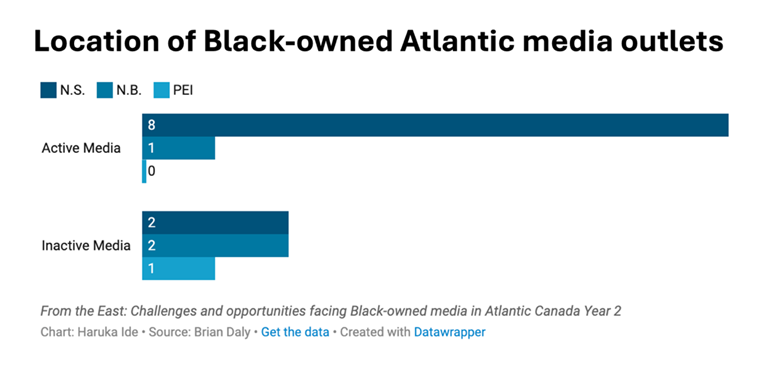
All nine active outlets analyzed for the King’s study were led by owners who self-identified as African Nova Scotian, African, or Black Canadian. They are not being named pending ethics-board approval to conduct interviews for the research study. The Atlantic publications run the gamut from magazines and websites to podcasts and YouTube channels. Eight of the nine active outlets were based in Nova Scotia, and one was in New Brunswick. None of the active outlets was based in Prince Edward Island or Newfoundland and Labrador; one P.E.I. publication is defunct.
All 14 outlets, whether active or not, had a digital footprint; however, a close look at their public-facing measurables indicated an online presence was not the ultimate recipe for success.
Missing out on media funding
Revenue streams were keys to survival as of July 2026, according to the preliminary findings in Year 1 of the five-year study. Three of nine active Black Atlantic media outlets had donation buttons only, four exclusively had ads, and two publications displayed sponsored content as their visible revenue generators. Meanwhile, none of the five inactive Black outlets had paywalls or ads, only one had a listed sponsor, and one had a donate button, suggesting that their sources of income were more limited than publications that remained active as of July 2026. All of the media outlets, whether active or inactive, listed teams of between one and three people each.
Ontario media entrepreneur Roger Dundas, whose publication ByBlacks.com is outside of the geographic boundaries of the study, uses the word “bootstrapping” to describe the early years of his now 14-year run as publisher of the magazine that covers Black Canadian business, history, and art.
Dundas launched ByBlacks.com in 2013 with his wife and veteran journalist Camille Dundas, just as Canadian media was in the throes of a collapsing print advertising market, a siphoning of readers by foreign social media giants, and scarce domestic funding options.
Roger Dundas says he self-financed ByBlacks.com for the first four years of its existence, until another option emerged.
“In 2017, a friend tapped me on the shoulder and said, ‘hey, there’s a grant that could help you … that you wouldn’t have to pay out of your own pocket,’” Dundas said from his office in Whitby, Ont. “She sent me a link, and that began my now almost 10 years of receiving different grants from different organizations.”
ByBlacks.com lists the Canadian Periodical Fund and Ontario Creates as its funding agencies. The company also has several categories of digital banner ads, sponsored content and paid directory listings — 12 distinct revenue sources in all.
Conversely, Black-owned media in the four Atlantic provinces in the study showed no evidence of sponsorship from any of the external funding agencies that support Canadian news media.
For instance, the recently established $3.8 million Journalism Futures Fund did not include Black-owned media based in Atlantic Canada for 2025-2026. The JFF, run by Inspirit Foundation, supports “small-to-medium organizations that deliver trustworthy independent journalism reflecting community realities” and prioritizes media led by journalists from under-served communities in Canada.
Similarly, the federally-funded Local Journalism Initiative supports the creation of original civic journalism “covering the diverse needs of underserved communities across Canada.” Its 2024-2025 list of recipients did not include Black-owned East Coast media according to News Media Canada, during a period in which more than $60 million in funding was available (Treasury Board of Canada Secretariat, 2026). An even larger sum of $100 million is available annually, from Google, through the Canadian Journalism Collective.
It was not immediately clear why Black-owned media on the east coast were not funded by the major envelopes.The research did not include questions on whether they had applied for any of these funds or had applied and been rejected.
It bears noting that the editorial focus of active Black-owned media on the east coast, with their emphasis on community service, journalism, and information sharing, closely mirrored the priorities of available media funding programs. However, Dundas said bridging the awareness gap will be required, to bridge the funding gap.
“You don’t know what you don’t know, right?” he said, in sharing his own experience of trial and error in finding the right financial footing for ByBlacks.com. “It’s work. It takes time,” he emphasized, highlighting the importance of research.
Community, or individual, focus?
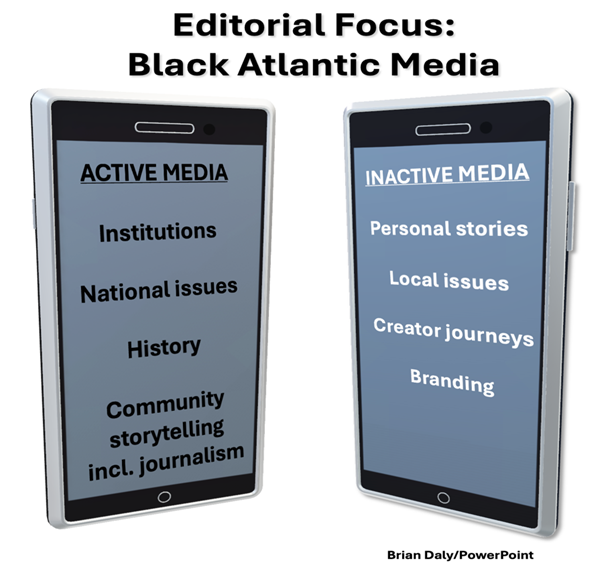
The King’s analysis suggests the viability of Black-owned East Coast media that remain operational could be connected to having a focus on big-picture issues,
The sustainability of these outlets was also tied to publishing frequency, the analysis found. Active Black Atlantic media published an average of 57 posts in a year, while inactive media delivered 40 posts annually. Active media had published for 7.6 years on average, with the earliest launch dating back to 2005 in one case.
Newsletters a key platform
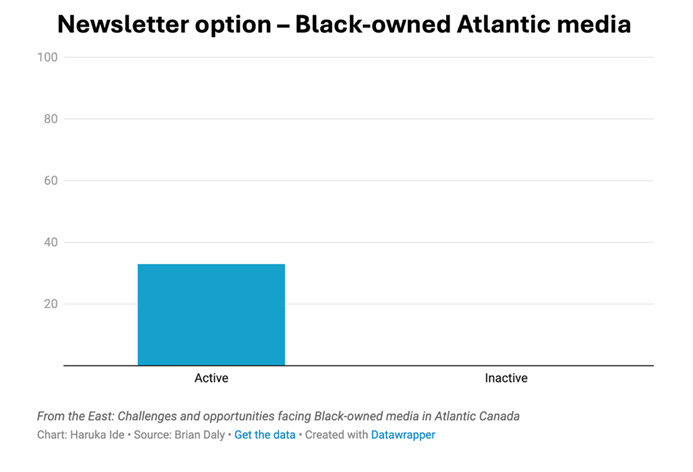
In his 2026 report Making News Media Sustainable, independent Canadian Senator and former CRTC commissioner Andrew Cardozo said newsletters serve multiple critical functions such as fostering deeper audience engagement, boosting subscriptions, and acting as a bulwark against the financial and operational volatility of social media algorithms. A newsletter appeared to be a significant separator between active and inactive Black Atlantic media. None of the defunct outlets operated newsletters, while one-third of active publishers did so.
The limits of platform monetization
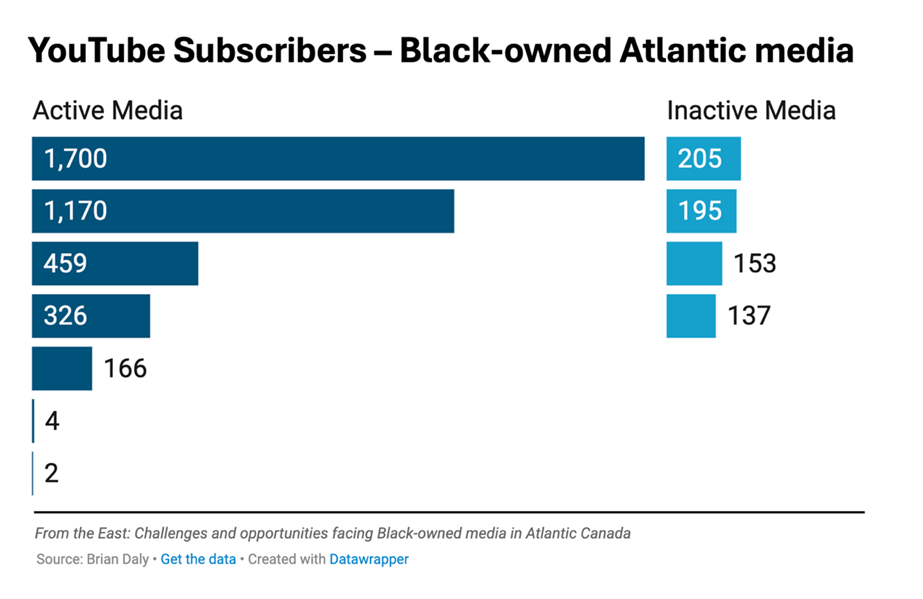
While 11 of 14 active and inactive Black-owned media on the east coast had YouTube channels, very few reached the threshold to unlock monetization. As of July 2026, YouTube said one of its users would need at least 1,000 subscribers to unlock revenue sharing from ads and the premium service — a bar that was cleared by just two of 11 Black-owned publishers, east of Quebec, that used the video platform. Subscriber data indicates that simply establishing a presence on a video platform does not automatically translate to sustainable revenue.
Future research directions
Year 2 of the King’s study will include interviews with Black publishers to better understand the ways in which they serve their communities in a tough economic environment. The research team at the University of King’s College will also organize focus groups from among Black communities in the four Atlantic provinces for wide-ranging discussions about the topics raised in the study.
The research project aims to bridge the gap between structural challenges and actionable solutions, ensuring that Black-owned media can continue to serve as a vital pillar of the region’s media ecosystem.
Graduate Research Assistant Haruka Ide reviewed literature, conducted data analysis and built graphics for this story. She also adapted Prof. Daly’s research paper and conference presentation into a rough draft of the article.
About the research: This project is funded by an Insight Grant from the Social Sciences and Humanities Research Council of Canada (SSHRC). For purposes of the study, “Black-owned media” is defined as a media outlet that operates in one or more of the four Atlantic provinces and is owned and operated by a Black person. This research defines “media” as public-facing organizations producing evidence-based content with an informational, educational, cultural, or entertainment focus.

Brian Daly
Assistant Professor
University of King’s College School of Journalism, Writing & Publishing