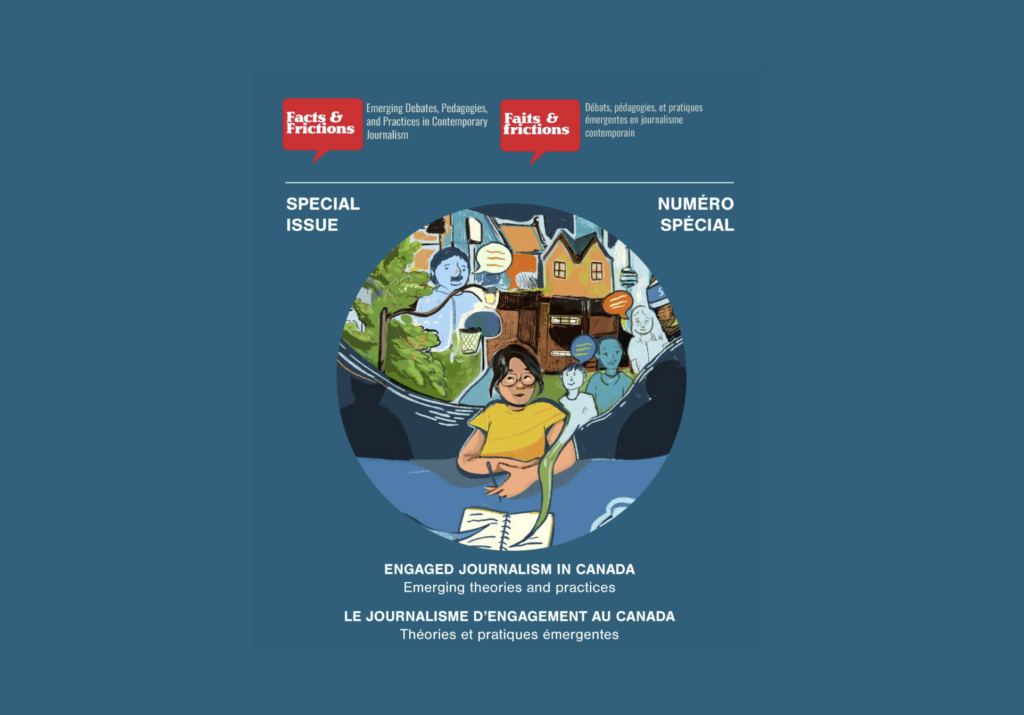
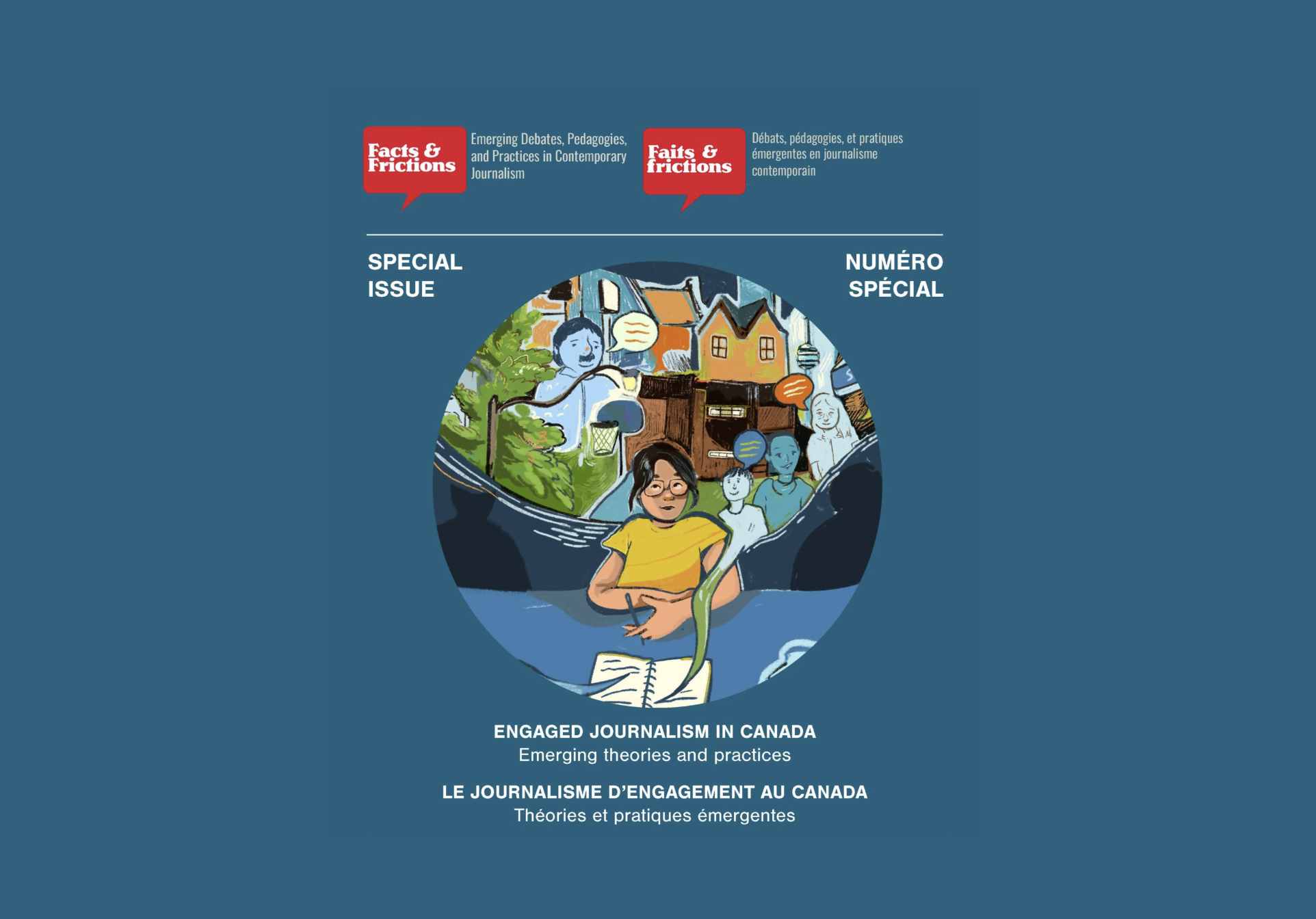
Introducing Facts & Frictions’ special Spring 2026 issue on engaged journalism
This special issue on engaged journalism comes out of an inkling and an observation: we had a glimmering sense that across Canada, journalists and news organizations were enacting new ways of engaging their audiences in the production of journalism. At the same time, we observed little recognition of the fact that these journalists were working on a common project—that by trying to find new ways to connect with the public as citizens, not just as consumers, they were in fact building something new, together. The concept of engaged journalism has gained steam in many places around the world, with conferences (ours last year, which inspired this issue, and others), new professional awards, guides such as that produced by the European Journalism Centre (n.d.), initiatives like the Pulitzer Center’s call for participatory radio program proposals, and books published on the topic, including Sue Robinson’s (2023) How Journalists Engage: A Theory of Trust Building, Identities and Care. Definitions of the concept already exist. In one of the most prominent works on the topic, Andrea Wenzel (2022) argues that engaged journalism can be understood as “an umbrella term referring to practices and principles that seek to build relationships between journalists and the public” (p. 570).
So far, there has been little written or collected about how this is playing out across Canada. And yet, our inkling that journalists were doing this work here proved true. When we both started thinking about engaged journalism in the Canadian context, first individually and then together, what we found was a bit of a silent shift—an existing sprinkling of efforts scattered across a vast geography where journalists had started to intuitively re-organize their professional orientations to include their audiences in the process of making news, largely in response to a decline in trust.
It was our own experiences, in both research and the classroom—and as consumers of journalism—that helped us identify this shift. And we came together out of a hope that, by naming and fleshing out these efforts, we can be more intentional about sharing what we know and start learning from each other.
Gabriela started teaching community-centred journalism to her students at Mount Royal University in 2022. Based on Wenzel’s (2020) book bearing the same name, the course doubles as theory and practice of engaged journalism and, though the theory is largely based on American case studies, it has increasingly become about emerging engaged practices in Canada. Students now consistently produce meaningful work as the product of intentional engagement with specific communities, such as the Ageing in Calgary project, where students have produced stories with and about older adults in Calgary (The Calgary Journal, n.d.).
Magda came to this work through inspiring colleagues in the United States, including Andrea Wenzel and Sue Robinson. Upon returning to Canada, she wondered about the state of engaged journalism here. There was little written on the topic, but slowly she began to discover journalists who were doing innovative work around projects that fit the description. That led to a desire to bring folks together to discuss and learn from each other (through conferences in Montreal and Toronto), to create a written record (this issue), and to experiment with starting Documenters Canada, an engaged journalism project which trains and pays community members to document public meetings, and which is described in one of the papers included here.
By organizing two national engaged journalism conferences, in Montreal in 2024 (with the help of Gabrielle Brassard-Lecours) and in Toronto in 2025, we’ve learned more about trail-blazing work happening around the country. We’ve heard from participants about how centering news production around engaging communities—and caring about their wellbeing—is transforming journalism in our country and charting a way forward for a profession battered by existential threats (Cheruiyot, 2024). More importantly, we witnessed a powerful realization among conference attendees, as they recognized themselves as part of a community trying to strengthen journalism’s chances to survive by involving the communities it serves.
Many of the pieces here were ideas or projects first presented at the second engaged journalism meeting in Toronto in 2025. But others are contributions that authors submitted responding to the special issue call that proved powerful and even surprising additions to our nascent knowledge of what is happening in this space. We love that there’s a journal dedicated to Canadian journalism, and that it publishes works of journalism as well as academic pieces. We couldn’t think of a better home than Facts & Frictions for this discussion.
We see this as a watershed moment, to have these scholars and practitioners gathered in a single volume, working together to sketch out this new field.
The issue contains multimedia works of journalism, research notes and full academic papers, each providing a way into the conversation about engaged journalism in Canada, spanning provinces and including Indigenous communities, the North, and Francophone Quebec. Together, they paint an emerging picture of the ways in which journalists, educators, scholars, and others are coalescing around new definitions not only of what journalism should be but also why it matters that we talk about it.
In this introductory essay, we take a moment to gather what we know about engaged journalism at large and then propose an emerging understanding of its various expressions across Canada.
What is engaged journalism?
In recent scholarly literature, engaged journalism appears as one of the many flavours of journalism to emerge as once-fundamental norms such as objectivity and maintaining a distance from sources have eroded, especially when reporting on marginalized communities (Konieczna & Santa Maria, 2023).
Other orientations include solutions journalism, exemplified today by the Solutions Journalism Network; community-centered journalism, with collaborative projects like Stories of Atlantic City; public or civic journalism that spurred projects like The Citizen’s Agenda to transform election coverage; citizen journalism of the kind supercharged by social media as seen during the Arab Spring, and so on. These concepts are not new, nor are they all based in North America—they share their origins in the movements of peace and participatory journalism that sprung up around the globe in the 1960s and 70s (Espinar Ruiz & Hernández Sánchez, 2012) and have a common goal and concern: the idea that journalism as a one-way mode of communication is not enough to realize the democratic promise and exigency to build and maintain civic cultures.
Some scholars have dated this realization to the emergence of digital technologies and the internet’s impact on blurring roles: suddenly, sometime in the 1990s, everyone was a journalist (Rosen, 2012). But, this was clearly more than a purely technological change, forcing the question of why we as the masses should listen to any one privileged voice in particular. This was the budding era of the Blogspots of the world, and the notion that by stumbling upon the musings of a random 15-year-old in Regina or Omaha, we might learn something universal about our own humanity.
This era also birthed citizen journalism (Atton, 2009). Initially, it seemed that by merely throwing open the door to citizen contributions, news would be broader, more diverse, more inclusive, and more democratic. If the promises of that early era feel utopian now, they also feel naive. By the first decade of the 21st century, it became clear that citizen journalism projects were facing some of the same challenges as traditional newsrooms, including power imbalances and hierarchies (Pickard, 2006). Our collective naivete made the situation ripe for “media capture,” by capitalism and by special interests (Schiffrin, 2017). It remains tempting to believe that we may one day achieve a public sphere that allows the best ideas to rise to the top. For now, as a society we have not succeeded at designing such a media system.
At its most essential, engaged journalism, understood in Wenzel’s (2022) broad terms, recognizes that avoiding capture requires an intentional approach to reporting the news. It also requires a much broader lens for what we mean when we say that journalism is a linchpin of democracy, where “democracy” itself needs to mean more than a system of government—our fundamental understanding must be that we live in community and are interdependent on each other, as the late James Carey (2008[1989]) argued well before the turn of our century.
What is different about engaged journalism in the Canadian context?
The most prominent examinations of the meaning and role of engaged journalism are based on the re-imagining of American media since the early 2000s. Much of it is based on attempts to restore trust with communities of colour and communities underserved by local news as many small outlets have given way to heavily concentrated news offerings in major brands and networks that focus on larger regions and national reports (Wenzel, 2022). There is no equivalent in the Canadian context in terms of a cohesive attempt to understand what engaged journalism looks like—or what it is—here. But that’s not to say that we lack examples of engaged journalism practices and education. Quite the contrary.
During this same time period, journalists in Canada have made efforts to develop a more engaged journalism here, informed by our own context and histories. There are plenty of examples of engagement efforts if we understand the concept in Wenzel’s generous terms. This can look like asking members of a community what they’d like journalists to work on, something Taproot Edmonton has been doing since launching a decade ago and continues to refine, for example around election coverage (Taproot publishing, n.d); or turning news into “action journeys” as The Green Line does in Toronto (The Green Line, n.d.); co-creating news pieces with survivors of climate change, which the Victoria-based Climate Disaster Project has implemented (Climate Disaster Project. n.d.); or creating dedicated engagement roles such as “community engagement producer” as some CBC bureaus have done (CBC.ca, n.d.). This is by no means an exhaustive list, but together all these efforts show that intentionality is a critical aspect of engaged journalism, and that plenty of people are intuitively doing it across the country. As Callison & Young (2020) have noted, many news startups in the past 20 years can be seen as efforts to “repair” journalism. In setting out to do things differently, many didn’t realize they were doing engaged journalism until their own audiences told them they appreciated their commitment to community engagement.
In the Canadian context, we would argue that the turn to engagement has largely, though not exclusively, been born out of challenging our media’s historically fraught relationship with Indigenous communities—something that several pieces in this special issue address. For example, outlets like The Narwhal and La Converse built anti-colonial practices into the DNA of their news organizations.
Over the past two decades or so, several major developments have marked a shift in how journalists report on Indigenous matters, encouraging engagement with audiences and especially the communities they report on. Among them are Duncan McCue’s launch of Reporting in Indigenous Communities, an online resource, in 2011 (Reporting in Indigenous Communities, n.d). This site quickly became an important hub for educators and newsrooms across the country, and eventually the basis of McCue’s (2022) Decolonizing Journalism: A Guide to Reporting in Indigenous Communities. The book is now a widely adopted guide in journalism education programs in Canada. Another major development was prompted by the Truth and Reconciliation Commission of Canada (TRC), whose mandate was to document and show Canadians the true history of the horrors inflicted upon Indigenous individuals through residential so-called “schools” (National Centre for Truth and Reconciliation, n.d.). The TRC’s 94 calls to action, issued in 2015, included three related to media:
-
- We call upon the federal government to restore and increase funding to the CBC/Radio-Canada, to enable Canada’s national public broadcaster to support reconciliation, and be properly reflective of the diverse cultures, languages, and perspectives of Aboriginal peoples.
- We call upon the Aboriginal Peoples Television Network, as an independent non-profit broadcaster with programming by, for, and about Aboriginal peoples, to support reconciliation.
- We call upon Canadian journalism programs and media schools to require education for all students on the history of Aboriginal peoples, including the history and legacy of residential schools, the United Nations Declaration on the Rights of Indigenous Peoples, Treaties and Aboriginal rights, Indigenous law, and Aboriginal-Crown relations. (National Centre for Truth and Reconciliation)
These calls to action spurred conversations and change across journalism schools in Canada (Gillmore, 2018), giving new weight and meaning to existing calls for changing the relationship between journalism and Indigenous communities and individuals. McCue’s work was eventually joined by other influential publications such as Candis Callison and Mary Lynn Young’s Reckoning: Journalism’s Limits and Possibilities (2020), which called for a renewed ethical approach to reporting in and with Indigenous communities.
Industry organizations such as the Canadian Association of Journalists have since supported the TRC’s calls to action (CAJ, 2021). All the while, Indigenous-led news organizations such as IndigiNews, founded in 2020—and, importantly, fully Indigenous-owned by 2025 (Mooney, 2025)—began to gain prominence across the country, while news start-ups such as The Narwhal launched with explicit intentions to engage with Indigenous authors, sources, and communities (The Narwhal, n.d.).
These efforts, which have meant to challenge traditional and harmful practices when reporting in and around Indigenous communities, have had an impact on the practice of engaged journalism in Canada. They have resulted in journalism that is more intentionally rooted in respect and reconciliation, reciprocity, and care. Moreover, they’ve inspired others seeking to redress harms caused by journalism in various communities historically othered by traditional media practices. Works such as Brad Clark’s (2022) Journalism’s Racial Reckoning, Christopher Cheung’s (2024) Under the White Gaze and Desmond Cole’s (2020) The Skin We’re In have helped support the notion that there is much more work to be done to challenge the status quo. Re-engaging various communities that have been mistreated in the news must be part of that effort.
Most recently, echoing McCue’s work with Indigenous reporting, Nana aba Duncan and Eternity Martis launched Reporting in Black Communities, described as “a project dedicated to transforming how Canadian media covers Black communities” (Reporting in Black Communities, n.d.) and offering another guide that will further inform how engaging more, and engaging differently, with communities can transform journalism for the better.
This special issue
Contributions to this issue take seriously what we’ve outlined above: intentional approaches to see community members as active co-creators rather than passive audiences. The pieces include one work of journalism, one praxis piece, four research notes, and four scholarly articles. Every piece underwent a rigorous peer review process, including the praxis and work of journalism.
Kristy Snell and Aleisha Teionerahtáthe Diabo’s (2026) praxis piece explains a collaboration bringing together high school students from Kahnawà:ke Survival School and journalism students at Concordia University. The university students helped the high school students learn about journalistic writing and production, while the high school students taught the university students about stories that matter to their community, Kahnawà:ke. Snell and Diabo write that the project “is the opposite of the traditional extractive approach to journalism, where reporters parachute into a community to cover a story with little connection or context, often causing harm through their approach and reporting” (p. 24), adding, “What is unique about this project is that it positions both sets of students as experts” (p. 24). In addition to sharing works of journalism that they produced together, Snell (a university professor) and Diabo (a participating high school student) share a conversation about the experience of watching a story produced through the project on the big screen, and the gratification of knowing that thousands of others had watched it, too.
Aphrodite Salas (2026) offers ᑰᒃ ᑰᑦᑐᖅ The Flowing River, a 19-minute documentary exploring “both the run-of-river hydro project that now powers the village of Inukjuak in Nunavik, and the relational flow of journalism that emerges from reciprocity with Inuit climate leaders” (p. 33). In her introduction, Salas reflects on how this engaged approach challenges Western norms like objectivity, positioning her work in conversation with recent theories that place “trust-building, identity and care” at the centre of journalistic practice (Robinson, 2023, p. 91) and wondering what it really means to report with “a view from somewhere” as proposed by journalism critic Lewis Raven Wallace (2019).
The four research notes in this issue offer various reflections—and provocations—to get us thinking seriously about what engaged journalism looks like both in theory and in practice in Canada.
François Demers (2026) contextualizes engaged journalism in Quebec as a movement coming out of French-language community media in the 1970s and ’80s. He looks back to the 1986 « Rapport du Groupe de travail sur la politique de la radiodiffusion », known as the Caplan-Sauvageau Report, which examined and described the role of community media in Canada, and explains how this laid the groundwork for engaged journalism here. Finally, he explores the unique role of francophone Quebecois journalists, who, he argues, have long been approaching communities in engaged ways.
Meg Wilcox and Ashley King (2026) reflect on the production of their award-winning podcast Static: A Party Girl’s Memoir, which was created in collaboration with Inside Out Theatre in Calgary. The authors discuss what it meant to tell King’s real-life story of losing her sight to methanol poisoning in an audio production based on King’s play. Their conversation involves discussion around how the values of disability justice and community informed an ethic of care in their work, creating a nurturing and trusting relationship that allowed for true collaboration and the development of best practices around consent and sharing traumatic personal narratives.
Adam Gamwell and Emily Kennedy’s (2026) research note proposes that engaged journalism practitioners already borrow heavily from the field of anthropology—without necessarily knowing it—and that by defining a discipline of “ethnographic reporting” as a category within engaged journalism, we enable practitioners to connect with and learn from others who are using similar methods. Gamwell and Kennedy note that, “Both traditions recognize that understanding emerges through continued presence” (p. 63). They conclude that anthropology’s long reckoning with the harms it has caused offers important lessons for journalism.
Kanina Holmes (2026) offers a provocative—even wild—premise: that we can “wild” journalism through relationality by considering “collaboration with the more than human” (p. 68). Her note raises important questions about engaged journalism that take into account the theory of “wild pedagogies,” with implications for the practice and pedagogy around journalism. Holmes reflects on a potential avenue for research that can transform “story ideation, sourcing, forms, ethics, relationships, and responsibilities” in journalism (p. 69), and anchors the piece to the context of emerging jurisprudence considering “personhood” for natural habitats such as rivers.
The scholarly articles in this issue help us understand how journalists can and should deploy an ethic of care with communities.
Emily Blyth, Mo Korchinski and Lyana Patrick (2026) work with a focus group of people affected by police violence to examine the coverage of a particular instance of police killing a man in British Columbia. The focus group members identify helpful and harmful tendencies in the way the incident was reported, and offer recommendations for how journalists can more fully engage with the people affected by this kind of violence in their reporting. The findings are all the more powerful for the authors’ use of engaged research approaches to explore and make recommendations about engaged journalism.
Clément Lechat and Sara Mizannojehdehi (2026) base their exploratory research project on a case study of the first site of Documenters Canada, a program to train citizens to document public meetings. Using grounded theory, their paper examines the lessons learned from launching the program in a hyperlocal Toronto newsroom, contrasting expectations with the reality of implementation. They consider the Documenters’ program’s aspirations and limitations, its impact on journalistic standards, and the nuances of co-producing journalistic knowledge with citizens.
Laurence Butet-Roch (2026) offers an original window into questions about what engaged photojournalism looks like based on a study of news photos reporting on Aamjiwnaang First Nation’s proximity to the so-called Chemical Valley. Butet-Roch (2026) proposes “care for representational justice as central to engaged journalism” (p. 121), raising questions about the potential harms of visual representations of environmentally impacted communities. The research method itself offers much to think about. Butet-Roch uses participatory visual discourse analysis, whereby the researcher—who is also a photojournalist—and community members enter into dialogue around the ways in which the community, as news subjects, would like to be captured in news photography. The paper’s rich descriptions and reflections make evident the centrality of “a praxis of care” in engaged journalism.
Finally, Teresa Goff’s (2026) research paper argues for the potential implementation of a framework to measure the social impact of engaged journalism education. Her research is based on a case study of Voices in Durham, a multi-year, community-based journalism project, and the co-design of a Social Impact Dashboard with community partners. The research integrates social theory, theory of change, and standpoint theory to argue that community-centred projects can challenge institutional assumptions about what journalism students are expected to learn and practice. Goff notes, “when students move from self-oriented skill development toward an awareness of their responsibilities to the communities they serve, they are enacting the reciprocal civic contribution that post-secondary institutions are mandated but rarely equipped to measure” (p. 144)
Opportunities
Each piece in this special issue tells a unique story of how an era of engaged journalism is taking shape in Canada and how practitioners and scholars alike are beginning to conceptualize it. As several of these works highlight, at the centre of engaged journalism lies, as Butet-Roch (2026) notes in her piece, a “praxis of care” that guides new ways of connecting, interacting, and even collaborating with audiences. Most of the pieces in this special issue reveal local expressions of care and connection between those telling stories and those consuming them, who might be one and the same, as an intentional path taken towards restoring trust and redesigning a journalism ecosystem that remains an essential pillar of democracy—in its widest possible sense, as Carey would have it.
We know this is but the beginning of our collective understanding of engaged journalism across Canada, and recognize that this special issue is a glimpse into many other existing initiatives and conversations about this evolving orientation and practice. For now, we leave you with some concluding thoughts on practice, pedagogy and theory, and an invitation to continue growing this nascent body of work:
- Engaged journalism is occurring already as a practice in small and large newsrooms of all kinds across Canada. Recognizing its value and potential positive impact both on journalism and our society is an important step in unlocking its full potential.
- Educators are embracing engaged journalism in the classroom and finding innovative ways of teaching it. It will be important to develop a pedagogy associated with engaged journalism. We see in this issue examples of outstanding work that educators are doing within journalism programs, largely as stand-alone courses or projects. Yet we know that this approach is not always in the DNA of journalism programs and may even come into tension with more traditional ways of teaching. How we can establish engaged journalism as one of the many skills and approaches considered foundational in a journalism education is an important question to emerge from this special issue.
- This special issue plants the seeds for further theorizing what engaged journalism is, could be, and should be. We invite you to expand on this knowledge.
Several of our pieces reveal that engaged journalism practices have often emerged from efforts to manage what we could call “great divides:” Indigenous/settler; anglophone/francophone; textual/visual; human/nature, and so on. It makes sense that in Canada the engaged re-orientation of journalism has followed a similar path that other expressions of journalism as repair have done. Ultimately, these efforts have all emerged from a profound intuition telling us that our approaches must change—or, maybe, come back to their most basic impulses of interdependence and connection. While not a silver bullet by any means, engaged journalism as a praxis of care and connection can help us bridge and perhaps even overcome many of our fault lines. We hope you will answer our call to keep up the work in understanding how.
Acknowledgements
The editors would like to acknowledge all the participants in the Engaged Journalism 2025 conference, held May 31-June 1 at Toronto Metropolitan University. We are also grateful to everyone who submitted work to this special issue, as well as reviewers, proofreaders, translators and others who made this issue possible.
Dr. Magda Konieczna is Associate Professor of journalism at Concordia University. She is founder of Documenters Canada, an experiment in engaged journalism that trains and pays community members to document public meetings. Email: magda.konieczna@concordia.ca
Dr. Gabriela Perdomo is Assistant Professor at the School of Communication Studies at Mount Royal University. She is also editor-in-chief at J-Source and co-producer of the Spanish-language podcast Periodémica, which highlights the lives and careers of Latin American academics living in the diaspora. Email: gperdomo@mtroyal.ca
Facts and Frictions is published by J-Schools Canada, Canada’s national association for post-secondary journalism research and education. All content is open access and available via J-Source.