• Read
    • Labour
    • Business
    • Education
    • Field Notes
    • Law and Ethics
    • Technology
    • Policy
  • Work & learn
    • Journalism Jobs
    • Awards
    • Education Opportunities
    • Events
      • Submit an event
  • Projet J
    • Entrevue
    • Balado
    • Nouvelles
    • International
    • Liberté de presse
    • Archive
  • About Us
    • Editorial Board
    • Supporters
    • Contributor guidelines
Donate
J-Schools Canada
Facts & Frictions
Facebook Twitter X LinkedIn
J-Source
  • Read
    • Labour
    • Business
    • Education
    • Field Notes
    • Law and Ethics
    • Technology
    • Policy
  • Work & learn
    • Journalism Jobs
    • Awards
    • Education Opportunities
    • Events
      • Submit an event
  • Projet J
    • Entrevue
    • Balado
    • Nouvelles
    • International
    • Liberté de presse
    • Archive
  • About Us
    • Editorial Board
    • Supporters
    • Contributor guidelines
Search site...

Category / Read / Research

  • Context, readership, and clarity all have a role to play in deciding whether to print obscenities. Image courtesy of John Sandham.

    Swearing, by the (style)book

    By John Sandham for The Signal Kathy English is a busy person. As public editor of the Toronto Star for almost 10 years, she deals with dozens of issues every week relating to errors, omissions, or content. Of course, she doesn’t remember small details of stories that have produced complaints. Nevertheless, she remembers the public outcry over…

  • Image courtesy Walt Jabsco/CC BY-NC-ND 2.0.

    Canada’s criminal libel laws may threaten free speech

    By Mitchell Thompson Criminal libel laws in Canada’s Criminal Code are being used increasingly to suppress speech that is critical of public officials and employees, Ryerson journalism professor Lisa Taylor said. Speaking at Ryerson University on Nov. 1, 2016, alongside Osgoode Hall law professor Jamie Cameron and Ryerson journalism professor James Turk, Taylor said criminal…

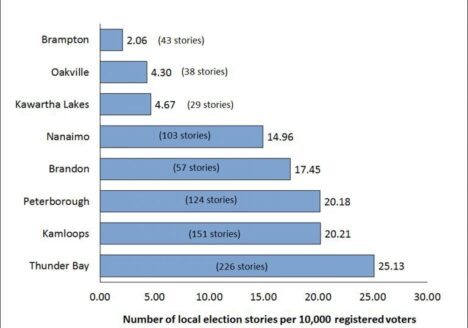
  • Local media coverage during the election. The research compared  local coverage of the race for MP in eight communities in Ontario, Manitoba and British Columbia. Image courtesy April Lindgren.

    Suburban and rural communities underserved by local media, new election research suggests

    By Jasmine Bala for the Ryerson Journalism Research Centre The amount of news available about local contests for member of Parliament during the 2015 federal election depended on where in Canada voters were living, a new study by Ryerson University’s Local News Research Project suggests. The research, which compared local coverage of the race for MP in…

  • Photo courtesy of Michelle-Andrea Girouard.

    What newsrooms are doing – and not doing – to deal with the mental health of their reporters

    By Trevor Hewitt  Weaving through busy streets on his gas scooter, Cliff Lonsdale thought about what was about to happen – after all, it’s not every day you’re sent to interview someone whose daughter has just been killed. As he reached his destination, Lonsdale knocked on the door. A woman answered. “Yes?” she asked, in…

  • Duncan McCue, CBC journalist and the Ryerson School of Journalism’s Rogers Visiting Journalist, at CBC’s Toronto studio. Photo courtesy Jasmine Bala.

    Duncan McCue works with Ryerson J-School on curriculum for covering Indigenous issues

    By Jasmine Bala for the Ryerson Journalism Research Centre  Reporters working in Canadian newsrooms should receive diversity training just like police officers and health workers do says Duncan McCue, the newly appointed Rogers Visiting Journalist at the Ryerson School of Journalism (RSJ). McCue said the training is necessary because journalists who don’t understand Indigenous cultures can cause…
  • Patti Sonntag awarded the Michener-Deacon Fellowship for Journalism Education to do project on Canadian resource extraction companies with 26 student journalists and partners. Photo courtesy Patti Sonntag.

    Patti Sonntag spearheads Canadian collaborative investigative journalism project

    This story was funded by the J-Source Patreon campaign. By Jane Gerster The first time Patti Sonntag tried to pitch a hands-on investigative class about resource extraction companies to Canadian journalism schools she was met with enthusiastic but noncommittal interest. It was 2014 and while schools were interested in the topic, Sonntag said, the project was…

  • Ugandan director Kamoga Hassan discusses his film, “Outed: The Painful Reality,” with journalist and queer media instructor Andrea Houston. Photo courtesy Jessica Ross.

    Film exposes role of Ugandan newspapers in persecution of LGBTQ community

    Queer Ugandan filmmaker lives in fear for his life, but is determined to keep telling stories from one of the most dangerous countries in the world for the LGBT community.

  • Canada’s access to information regime is systemically broken, says panel

    Accessing public information in Canada frequently entails multiple-year delays, seemingly arbitrary and generous redactions, and time-consuming appeals processes.

  • Kamal Al-Solaylee, Angelyn Francis and Jim Rankin discuss how reporters can get comfortable while covering controversial stories at an RJRC panel. Photo courtesy Madeleine Binning.

    Getting comfortable with being uncomfortable is part of a journalist’s job, say panelists

    Feeling uncomfortable while reporting on some communities and situations is part of being a good journalist.

  • Gavin Adamson, journalism undergraduate program director, presenting his findings at Ryerson University on Sept. 12, 2016. Photo courtesy Jasmine Bala

    Positive mental health stories more often shared online than negative stories, study finds

    The study by Gavin Adamson examined the content of articles dealing with mental health and how they were shared across digital platforms such as Facebook and Twitter.

Previous
12…1415161718…3334
Next

Michener Scholarship

J-Source logo

J-Source, led by the journalism programs at Toronto Metropolitan University and Carleton University, is supported by the post-secondary journalism programs at member institutions of J-Schools Canada/Écoles-J Canada, the R. Howard Webster Foundation and a group of donors.

PRIVACY AND J-SOURCE

© Copyright 2024. All Rights Reserved

FacebookTwitter XLinkedIn

This site uses cookies to offer you a better browsing experience. Find out more on how we use cookies and how you can change your settings.